
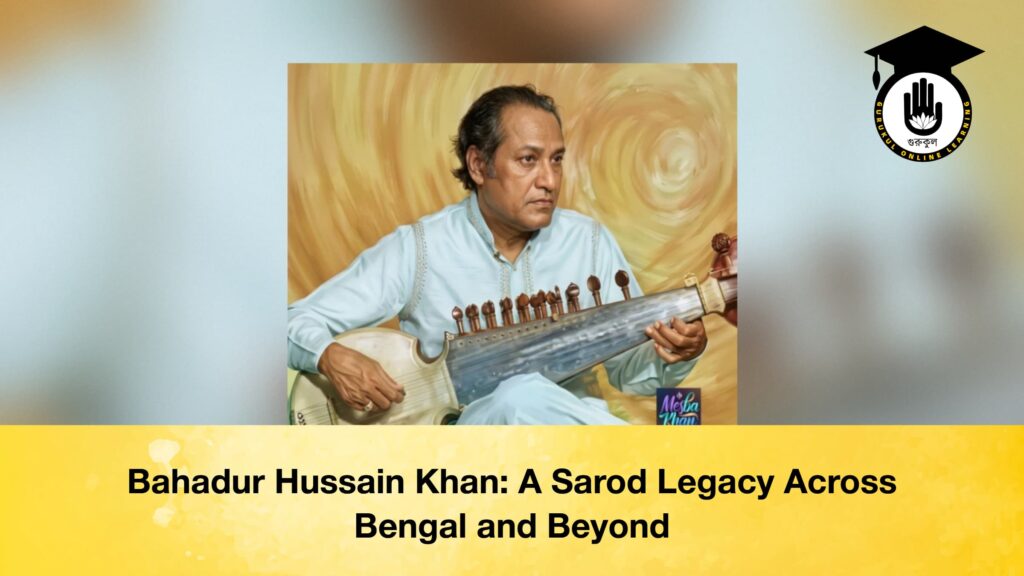
In the vast tradition of South Asian classical music, some musicians leave behind more than recordings and performances. Their work becomes part of a cultural memory, carrying the discipline of an older musical tradition into new artistic forms. Ustad Bahadur Hussain Khan was one such figure. A distinguished sarod player, composer and music director, he built a career that connected the rigorous world of classical music with dance, cinema and documentary filmmaking.
Bahadur Hussain Khan was born on 19 January 1931 in Shibpur village, in Nabinagar upazila of Brahmanbaria. He came from a distinguished musical family. His father, Ustad Ayet Ali Khan, was a renowned musician and sarod player, while his uncle was the legendary Ustad Allauddin Khan, one of the most influential figures in the classical music tradition of the Indian subcontinent.
Music was deeply embedded in the family. Several of Ayet Ali Khan’s children, including Abed Hussain Khan, Mobarak Hussain Khan, Sheikh Sadi Khan, Tansen Khan and Yasmin Khan, were associated with music and culture. Growing up in such an environment gave Bahadur Khan an early exposure to the demanding discipline of classical performance.
His first lessons on the sarod came from his father. His training later took him to Maihar, where he studied under his uncle Allauddin Khan for an extended period. The Maihar years were crucial in shaping his musicianship. Under rigorous instruction, he developed a strong grounding in the grammar of classical music, the structure and character of ragas, rhythmic discipline and the expressive possibilities of melody.
He began his professional career as a performer with Bangladesh Betar in 1949. Two years later, in 1951, he moved to Bombay, now Mumbai, where he became music director for dancer Shanti Bardhan’s Little Ballet Troupe. The assignment broadened his artistic horizons, bringing classical music into closer contact with dance and theatrical performance.
Yet Bahadur Khan’s contribution cannot be understood solely through his career as a sarodist. He was also a composer and music director whose work extended into one of the most significant periods of Bengali cinema.
His association with filmmaker Ritwik Ghatak stands out in particular. Bahadur Khan was involved musically with several of Ghatak’s films, including Meghe Dhaka Tara, Komal Gandhar, Subarnarekha and Jukti Takko Aar Gappo. His work demonstrated how the tonal language of classical music could be adapted to the emotional and dramatic demands of cinema.
Subarnarekha was among his notable film-music assignments. His wider body of work included films such as Natun Pata, Trisandhya, Jekhane Danriye, Shwet Mayur, Titas Ekti Nadir Naam, Garam Hawa and Jukti Takko Aar Gappo. In these productions, his classical training provided a strong musical foundation, while his understanding of visual storytelling allowed him to shape music around atmosphere, character and narrative.
His contribution was not confined to Indian cinema. In Bangladesh, his musical work included films such as Titas Ekti Nadir Naam and Nadi O Nari, where his approach to music and orchestration became part of the films’ broader artistic texture.
Bahadur Khan also worked beyond feature films. He directed background music for documentaries associated with major cultural figures, including Rabindranath Tagore, Allauddin Khan and artist Jamini Roy. These projects reflected the breadth of his musical vocabulary, which could move between classical performance, dance, cinema and documentary work.
Teaching was another important part of his career. Alongside his work in Kolkata, he taught Indian classical music at the Ali Akbar College of Music in California in the United States. His students included musicians who later established themselves in the classical music world, among them sarodist Tejendra Narayan Majumdar.
Recordings of Bahadur Khan’s sarod performances were released during his lifetime, although a considerable part of his work is not readily accessible today. The relative scarcity of recordings and documentation has made the preservation of his musical legacy an important cultural concern. For musicians whose careers predated the widespread use of digital recording and archiving, the survival of performances often depends on private collections, institutional archives and the continued efforts of researchers and music enthusiasts.
What makes Bahadur Khan’s career particularly notable is the way he carried a demanding classical tradition into different artistic settings without reducing his work to a simple repetition of inherited forms. The discipline he acquired in Maihar remained central to his musical identity, but he applied that foundation to the needs of cinema, dance and documentary storytelling.
His sarod could serve the expansive structure of a raga, but it could also contribute to the mood of a film scene or the emotional atmosphere of a narrative. That ability to move between artistic forms helped distinguish him from musicians whose careers remained confined to the classical concert platform.
Bahadur Hussain Khan lived for only 58 years. He died in Kolkata on 3 October 1989. Despite the relatively short span of his life, his career encompassed several roles: performer, composer, music director and teacher.
His story also reflects a wider chapter in the cultural history of Bengal and the Indian subcontinent. Born in Shibpur and trained in the demanding Maihar tradition, he worked across geographical and artistic boundaries, contributing to both classical music and the evolving language of South Asian cinema.
The sarod eventually fell silent, but the body of work Bahadur Khan left behind continues to offer a link between generations. His legacy survives not only in the recordings and films associated with his name, but also in the musicians he taught and in the continuing recognition of the musical traditions that shaped his career.
Remembering Ustad Bahadur Hussain Khan, therefore, means remembering more than a gifted sarod player. It means recalling an artist who carried the discipline of classical music into wider cultural spaces and helped demonstrate how an inherited musical tradition could speak through new forms of artistic expression.
His life may have ended in 1989, but the musical tradition to which he devoted himself continues to resonate. In the history of South Asian music and Bengali cinema, his name remains associated with a distinctive journey from the rigorous world of the sarod to the broader soundscape of the arts.