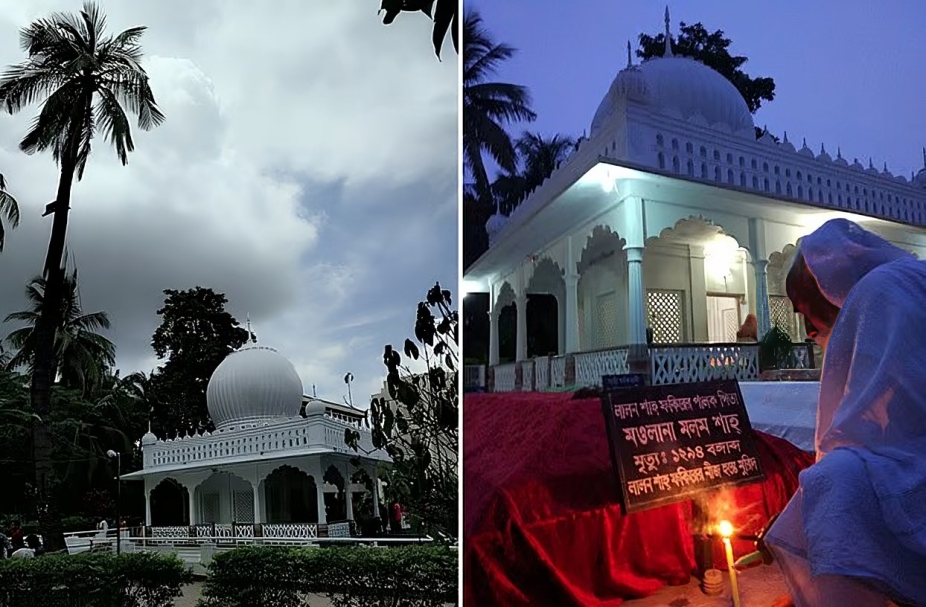
The devotional music born in Chheuriya, Kushtia, spanning the early to late nineteenth century, was not merely the voice of a regional spiritual order; it constituted a landmark melodic revolution in Bengali literature. At a time when the faith-based nationalist tendencies of orthodox Muslim and Hindu societies were fracturing the social fabric, Fakir Lalon Shah articulated a philosophy of universal humanism, egalitarianism, and self-realisation (Atmatattva) through his compositions. Through colloquial language, metaphors drawn from daily life, and spontaneous rhythmic phrasing, Lalon created a musical atmosphere that might outwardly appear to be simple folk melody. However, rigorous examination reveals that it is intricately linked with the formal modes and ragic structures (Raga-vinhasa) of Indian classical music.
Table of Contents
Heritable Legacy: Influences of Kirtan, Padavali, and Ramprasadi
No musical tradition emerges in a vacuum. In composing his songs, Lalon Shah was profoundly influenced by his predecessors: Vaishnava Padavali, Shakta Padavali, and the Kirtan and Bhajan traditions originating from Nabadwip—the spiritual sphere of Sri Chaitanya Mahaprabhu. During his peregrinations through Nabadwip and various pilgrimage sites, the Kirtan melodies and esoteric somatic tunes (Dehatattvik melodies) he absorbed were reconfigured into his own philosophical framework.
“Sain has kept me like well-water,In a dark, blind pond.”(Rakhlen Sain kupojol kore, andhela pukure)
“Why speak of the Dark Lord to me today?At the mention of his name, a fire ignites within me, scorching my body.”(Kalar kotha keno bolo aaj amay, jar naam sunile aagun jole, ong-go jole jay)
Furthermore, the distinct influence of Ramprasad Sen’s Shakta compositions (Shaktagiti) on Lalon’s melodic and metrical structures is discernable. By introducing subtle variations to the standard metre of Ramprasadi compositions, Lalon fashioned his own devotional genre (Bhavgeet). For example:
“My mind has grown depraved,Thus I remain blind from birth.”(Moner holo moti mondo, tai to rolam ami jomno-ondho)
Although this song features three isometric stanzas (Antara) and retains the thematic resonance of the Ramprasadi tune, its overarching structure aligns with Lalon-shahi devotional songs. Similarly, traces of Ramprasadi metre can be detected in “Kaal katali kaler boshe” and “Mon bibagi baag manenare”. However, the most complete and successful application of the Ramprasadi melody is evidenced in Lalon’s celebrated composition:
“I call upon the Prophet, I call upon his name;Taking the Prophet’s name brings paramount joy.”(Rasul Rasul bole daki, Rasul naam nile boro sukhe thaki)
The Subtle Application of Ragas and Raginis in Lalon Geeti
1. Bhairavi and Shivaranjani
“Who knows when the bird will fly away,Struck by an ill wind in its cage.”(Pakhi kokhon jani ure jay, bod hawa lege khancay)
2. Purvi and Dhanashree
“Bailing water endlessly, yet this broken boat yields not;Throwing out one bucket brings in three into the hold.”(Chirodin jol shechiye jol mane na, e bhanga nay…)
3. Uparaga Devagiri
“What a strange affair, crying ‘caste is lost, caste is lost’.”(Jaat gelo jaat gelo bole eki aajob karkhana)
4. Bageshree and Dhime Ektaala
“On the day emotional awakening dawns,Beauty shall flash upon the lotus of the heart.”(Bhaver uday jedin hobe, ese hridoy-komole roop jholok dibe)
5. Raga Desh
“Who can comprehend Krishna’s boundless play?Why leave Braja to become a king in Mathura?”(Ke bojhe Krishner opar leele, Brojo chhere Mathuray keno raja hole)
Metrical Structures and Dhrupad-Style Arrangement
An examination of the rhythmic framework (Tala-vyavastha) in Lalon Geeti indicates a primary reliance on symmetrical two- and three-beat metres in slow (Vilambit) and medium (Madhya) tempos. Nevertheless, to sustain the solemnity and meditative depth of his themes, Lalon did not hesitate to employ complex, asymmetrical classical metres.
“He whose mind is steadfastly devoted to the Guru’s feet,Shall be liberated from all unreality, attaining the priceless treasure.”(Guru pode nishtha mon jar hobe…)
Application of Dhrupad Style
In classical Dhrupad singing, there exists a tradition of expanding words or improvised phrases (Taans) alongside the natural descent of pitch oscillations. A successful poetic adaptation of this technique is embedded within the structure of Lalon Geeti. Upon completing a stanza (Antara) and returning to the refrain (Sthayi), specific words undergo sustained, Dhrupad-style melismatic extensions.
“I have not seen Him even for a single day;Near my house lies the Mirror-City, where my Neighbour dwells.”(Ami ekdin-o na dekhilam tare, barir kachhe Arshinogor, porshi bosot kore)
In this composition, words such as pare (bank), naire (there is none), and dure (far) in successive stanzas are extended using classic Dhrupad ornamentation. A similar structural motif is reflected in “Apon khobor aponar hoy na” (One lacks knowledge of oneself).
The Sufi Lineage: Hamd, Naat, Ghazal, and ‘Sama’ Music
Lalon Shah played a pioneering role in integrating Sufi vocal genres—such as the Ghazal, Hamd, and Naat—into Bengali songcraft. By synthesising the structural frameworks of Persian and North Indian Ghazals with the melancholic melodies of the Bengali Baul tradition, he created an innovative, dynamic fusion.
“O God of the Worlds, Allah, You are the Sovereign and Protector…”(Ilahi Alamin Alla, Badsha Alam Pana tumi…)
“My Prophet is the helmsman for the beyond,Unaware of the Prophet, spiritual devotion remains in pain…”(Oparer kandari, Nobiji amar…)
“Recite ever on your lips: La ilaha illallah…”(Mukhe podore soday La-ilaha-illalla…)
Musicological Evaluation and Synthesis
Although Lalon’s compositional technique was not constrained by the dogmatic dictums of formal musicology, the foundational aesthetic essence of classical music flowed beneath his songs like a subterranean stream. Rather than blindly imitating classical modal grammar, he synthesized the aesthetic essence of Ragas with his internal spiritual experiences.
When Lalon Geeti is performed in a contemplative, meditative setting, its intrinsic melodic richness and emotional profundity demonstrate that it forms an imperishable, integral branch of Bengali classical music. Much like Rabindra Sangeet and Nazrul Geeti, Lalon Geeti warrants an elevated, distinct position in the canon of Bengali music through systematic musicological analysis and academic research.
Bibliography & References
1. Authentic Studies on Lalon Geeti, Melody, and Rhythm Analysis
- Chowdhury, Abul Ahsan (Ed.) — Lalon Samagra [The Complete Works of Lalon], Pathak Samabesh, Dhaka.
- Goswami, Karunamaya — Bangla Ganer Itihas [History of Bengali Songs], Bangla Academy, Dhaka. (Specifically the section on the interaction between Lalon Geeti and classical modes).
- Chakraborty, Sudhir — Bratya Lokayata Lalon [Subaltern Folk Lalon], Pustak Bipani, Kolkata.
- Rahman, Sain Lutfar — Lalon Shaher Gan: Sur O Tal Bishleshon [Songs of Lalon Shah: Analysis of Melody and Rhythm], Bangla Academy, Dhaka.
- Islam, Syed Zahurul — Lalon Geetir Sur O Kavyachinta [Melodic and Poetic Thought of Lalon Geeti], Bangla Academy, Dhaka.
2. Classical Music, Raga-Ragini, and Folk Music Relations
- Bhattacharya, Upendranath — Banglar Baul O Baul Gan [Bauls and Baul Songs of Bengal], Orient Book Company, Kolkata. (Discussion on the influence of Kirtan, Ramprasadi, and Ragas on Baul music).
- Goswami, Karunamaya — Sangeetkosh [Encyclopedia of Music], Bangla Academy, Dhaka.
- Bhowmik, Shaktipada — Bangla Lok Sangeete Shastriya Sangeeter Probhav [Influence of Classical Music on Bengali Folk Music], Firma KLM, Kolkata.
3. Influence of Vaishnava Padavali, Shakta Lyrics, and Sufi Traditions
- Mansur Uddin, Muhammad — Haramoni [Lost Gems] (Vols. 1–13), University of Dhaka and Bangla Academy, Dhaka.
- Sharif, Ahmed — Baul Tattva [Baul Philosophy], Vishwavidyalaya Prakashani, Dhaka.
- Khan, Azahar Uddin — Ramprasad O Lalon: Sur O Bhav Tulona [Ramprasad and Lalon: Comparison of Melody and Mood], Muktodhara, Dhaka.
- Haq, Muhammad Enamul — Arakan-Rosang Rajsobhay Bangla Sahitya O Sufi Probhav [Bengali Literature and Sufi Influence in the Royal Court of Arakan-Rosang], Bangla Academy, Dhaka. (Contextualizing Sufi Sama music and somatic philosophy).