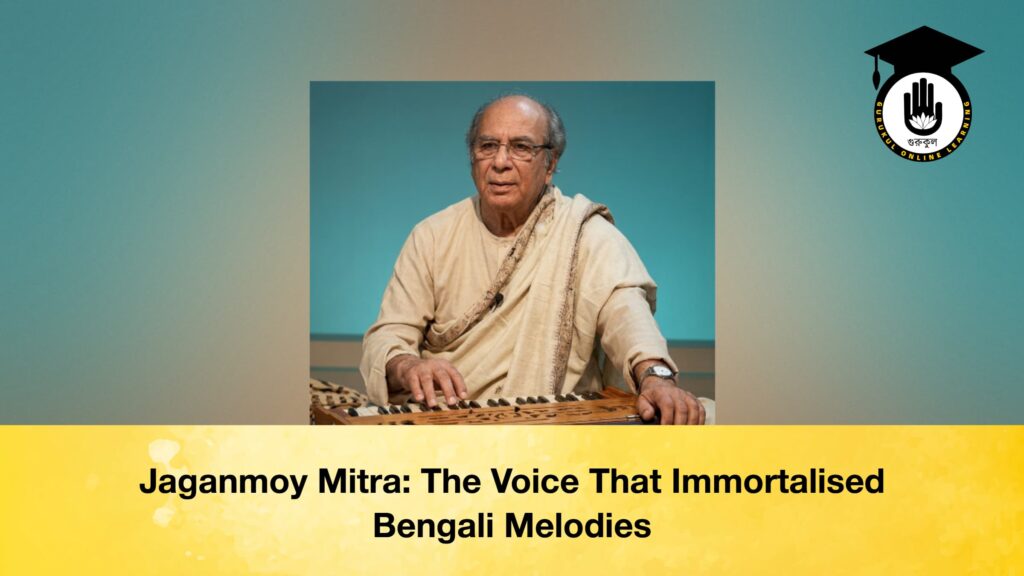
In the history of Bengali music, certain voices transcend their own era. Their songs continue to resonate long after the singers themselves have passed away, finding new meaning in the experiences of successive generations. Jaganmoy Mitra was one such artist. Best remembered for his deeply expressive renditions of poetic songs, he gave Bengali music a distinctive vocabulary of love, separation, longing and emotional restraint.
Mitra was born on 6 September 1918 in Kolkata into a family with a strong interest in music. His childhood began under difficult circumstances. His father, Jatindranath Mitra, died at the age of only 25, just over a month before Jaganmoy’s birth. He was his parents’ only child and grew up without siblings. Despite the loss that marked his earliest years, music gradually became an important part of his life.
His family environment played a significant role in shaping his musical interests. His grandfather Bidhubhushan Mitra and uncle Panchanan Mitra were both enthusiastic about music. His uncle played the harmonium and received training in classical ragas from established teachers. As a child, Jaganmoy would sit nearby and listen. Those early encounters with music helped nurture an interest that would eventually become a lifelong vocation.
His formal education began at home, and he passed the Entrance examination in 1934. Alongside his studies, he continued his musical training. At around 10 or 11 years of age, he began learning different forms of classical music from Keshab Mukhopadhyay, including dhrupad, khayal, thumri and tappa. This broad grounding later contributed to the versatility that became a notable feature of his singing.
Table of Contents
Early recognition of an exceptional talent
A major breakthrough came in 1938, when Mitra took part in a music competition organised by the Bengal Music Association. He secured first place in several categories, including dhrupad, tappa, thumri, raga-based baul and kirtan. He also finished third in the poetic-song category.
The same year marked another important turning point. He was given the opportunity to record songs for HMV, beginning a recording career that would eventually make his voice familiar to generations of Bengali listeners.
Among his early recordings were ‘Priyo Hote Priyotor’ and ‘Tomar Moton Koto Na Noyon’, written by Pranab Roy and composed by Kamal Dasgupta. These songs helped establish his early reputation and introduced listeners to the distinctive quality of his voice.
A connection with Kazi Nazrul Islam
Mitra’s musical journey was also closely associated with Kazi Nazrul Islam. After hearing Mitra sing ‘Jodi Bashona Mone Dibe Dohon Jwala’ in an HMV recording, Nazrul praised the young singer’s voice. Their meeting developed into a warm and enduring relationship.
Mitra also recorded several Rabindra Sangeet compositions in 1941, demonstrating the breadth of his repertoire. A year later, he recorded two notable poetic songs, ‘Sat-ti Bochor Age’ and ‘Sat-ti Bochor Pore’. Together with ‘Chithi—Tumi Aj Koto Dure’, recorded in 1948, these songs became closely associated with the melancholic and romantic character of his musical legacy.
‘Chithi—Tumi Aj Koto Dure’ and lasting fame
Of all Mitra’s recordings, ‘Chithi—Tumi Aj Koto Dure’ occupies a particularly important place. Recorded in 1948, the song captured the emotions of distance, waiting and unfulfilled affection with an intimacy that made it remarkably relatable to listeners.
Its popularity extended well beyond the period in which it was first released. According to figures attributed to HMV, approximately 2.5 million copies of the recording were sold from the 78-rpm record era through the cassette period. If accurate, that scale of sales illustrates the extraordinary longevity and reach the song achieved within Bengali popular music.
The song also became closely identified with the poetic-song tradition, in which lyrical expression and melody work together to convey an intimate emotional narrative. Mitra’s restrained yet expressive singing style was particularly suited to this form.
A defining voice of love and separation
During the 1940s and 1950s, Mitra recorded numerous songs that became associated with his name. His repertoire included ‘Bhalobasha More Bhikhari Korechhe’, ‘Ami Duronto Baishakhi Jhor’, ‘Jader Jibon Bhora Shudhu Akhijol’, ‘Tumi Ki Ekhon Dekhichho Swapan’, ‘Bhuli Nai Bhuli Nai’, ‘Menichi Go Haar’, ‘Ami Swapan Dekhechhi’, ‘Swapan Surabhi Makha’, ‘Gobhir Nishithe Ghum’, ‘Premer Tajmahal’, ‘Hridoy Jeno Kahare Cheyechhilo’, ‘Tomare To Aaj-o Bhuli Nai’ and ‘Shaono Raate Jodi’.
These recordings helped define the emotional character of his musical identity. He could bring tenderness to songs of affection while giving songs of separation a restrained intensity. Rather than relying solely on dramatic vocal expression, his performances often drew their impact from the clarity of the words and the emotional weight he gave to each line.
Although he was accomplished in several forms of music, including classical traditions, Nazrul Sangeet and Rabindra Sangeet, it was as a singer of poetic songs that Mitra achieved his most distinctive reputation. His voice became particularly associated with themes that have remained universal: remembering someone who is far away, waiting for a loved one and living with the memory of a relationship that has ended.
A legacy that outlived the singer
Jaganmoy Mitra died on 4 February 2003. By then, his recorded music had already secured a lasting place in Bengali musical culture.
His significance lies not simply in the number of popular songs he recorded, but in the particular emotional character he brought to them. His singing helped establish a style in which poetry, melody and personal feeling could come together without excessive ornamentation. For many listeners, his recordings became closely connected with memories of youth, affection and separation.
Decades after his death, ‘Chithi—Tumi Aj Koto Dure’ remains the song most readily associated with his name. Its central theme—a message addressed to someone who is now distant—continues to carry a familiar emotional meaning. The song belongs to an earlier recording era, yet its subject remains timeless.
Mitra’s career also reflects an important period in the development of Bengali recorded music, when gramophone records, radio broadcasts and later cassette recordings helped carry individual voices into homes across generations. His recordings survived those technological changes and continued to introduce his work to new listeners.
Jaganmoy Mitra is therefore remembered not merely as a popular singer of the mid-20th century, but as one of the distinctive voices of Bengali poetic music. His classical training, versatility and particular gift for expressing romantic and melancholic lyrics gave his recordings a character that remains recognisable.
The singer’s voice fell silent in 2003, but the recordings remain. For listeners who turn to Bengali songs to recall love, distance or memories of another time, Mitra’s music continues to offer a familiar emotional language.
That enduring connection is perhaps the clearest measure of his artistic legacy. Jaganmoy Mitra may belong to another era, but his songs continue to travel beyond it.