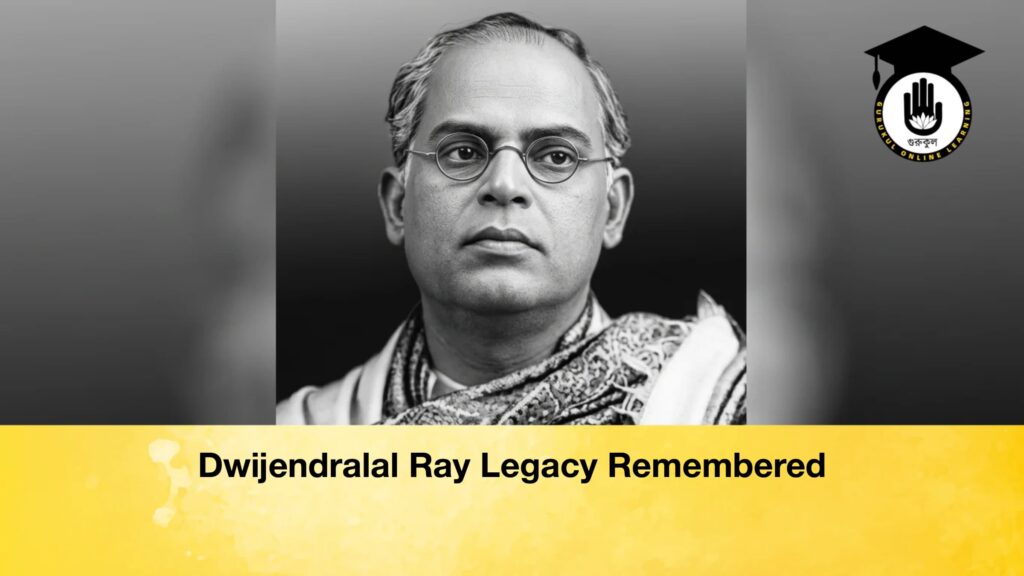
Dwijendralal Ray remains a distinguished figure in the history of Bengali literature, theatre, and music. His death anniversary is observed on 17 May, marking his passing in 1913. Although more than a century has elapsed since his death, his creative works continue to form an integral part of Bengali cultural expression and heritage.
Table of Contents
Birth and Education
Dwijendralal Ray was born on 19 July 1863 in Krishnanagar, Nadia. His father, Kartikeya Chandra Ray, served as the Dewan of the Krishnanagar royal household. From an early age, Ray demonstrated a strong inclination towards literature and music. He was recognised as a talented student and later travelled to England for higher studies.
In England, he studied agricultural science. During this period, he was also exposed to Western literature, music, and drama, which broadened his intellectual outlook. Scholars consider this phase significant in shaping his literary and artistic development.
Career and Literary Work
After returning to India, Ray joined administrative service under the British government. Despite his professional responsibilities, he continued to produce literary works across multiple genres, including poetry, songs, drama, and essays.
He gained particular prominence for his historical dramas, where historical narratives were presented not merely as accounts of the past but as reflections of national identity and dignity. His major plays include Mewar Patan, Shahjahan, Chandragupta, and Nurjahan, which are regarded as important contributions to Bengali dramatic literature.
Critics note that his works strongly reflect themes of patriotism and human emotion. During the British colonial period, his writings played a role in fostering a sense of national consciousness among the Bengali-speaking population.
Major Works Overview
| Category | Title | Notable Aspect |
|---|---|---|
| Drama | Mewar Patan | Historical and patriotic narrative |
| Drama | Shahjahan | Blend of history and human emotion |
| Drama | Chandragupta | Political and historical themes |
| Drama | Nurjahan | Character-driven historical portrayal |
| Song | Dhonodhanye Pushpe Bhora | Patriotic composition |
| Song | Bongo Amar! Jononi Amar! | Expression of national identity |
| Song | Ore O Bhai, Fagun Legeche Boney Boney | Nature-based lyrical composition |
Dwijendrageeti Tradition
The songs composed by Dwijendralal Ray are collectively known as Dwijendrageeti. This body of work is recognised as a distinct stream within Bengali music, alongside Rabindra Sangeet and Nazrul Geeti.
His songs encompass themes of patriotism, nature, humour, devotion, and human sentiment. The simplicity of language combined with melodic variation contributed to their wide acceptance among audiences.
Cultural Significance
Musicologists and literary scholars have noted that Ray’s compositions contributed to the development of patriotic music in Bengal. His works were performed during the era of the Indian independence movement and are considered to have influenced the cultural consciousness of the time.
More than a century later, his songs and writings continue to be performed at cultural events, national commemorations, and educational institutions. His literary and musical legacy is frequently referenced in discussions on Bengali cultural history.
Observance of the Anniversary
On his death anniversary, cultural organisations, literary societies, and music institutions across the country organise commemorative programmes. These include discussions, musical performances, and tributes. His songs are performed by artists, while his literary contributions are revisited by scholars and enthusiasts.
Dwijendralal Ray’s enduring presence in Bengali cultural history reflects the continued relevance of his work in literature, theatre, and music.