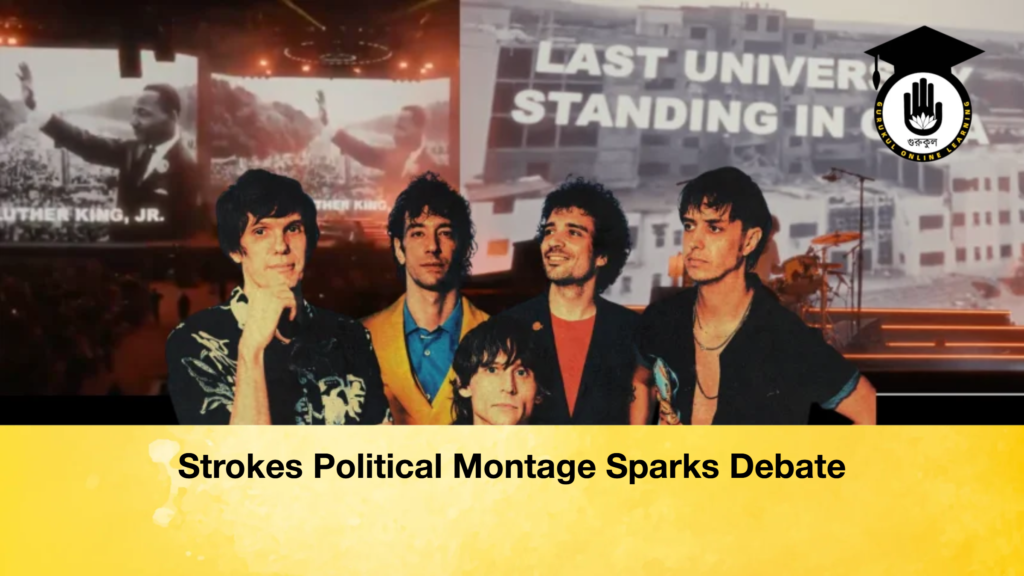
At California’s globally renowned Coachella Valley Music and Arts Festival, the second-weekend performance by American rock band The Strokes has drawn widespread attention after incorporating a striking visual-political presentation that extended far beyond conventional live music.
The set concluded with a lengthy video montage projected on large screens, featuring imagery linked to recent conflicts in Gaza and Iran, including scenes of airstrikes and destruction reported in those regions. The sequence also incorporated references to historical episodes connected to United States foreign policy, many of which remain subject to international debate and academic scrutiny.
During the performance, the band revisited their track “Oblivious”, a song not frequently performed live in recent years. Lead vocalist Julian Casablancas repeatedly delivered the phrase “which side are you on”, synchronised with the unfolding visuals. The interplay between sound and imagery intensified the thematic emphasis on moral positioning amid geopolitical conflict.
The montage further referenced allegations concerning the role of the United States Central Intelligence Agency in political interventions across Latin America, alongside depictions of several contentious historical incidents that continue to divide scholarly and public opinion. The visual narrative was constructed in a way that deliberately juxtaposed modern conflict zones with Cold War-era political upheavals.
The final segment of the presentation returned to contemporary scenes from Gaza and Iran, culminating in the symbolic image of a bomber aircraft, which marked the conclusion of the set. The closing sequence prompted a strong response from sections of the audience and quickly circulated across social media platforms, generating extensive debate.
A summary of key historical and geopolitical references included in the montage is presented below:
| Event | Year | Location | Notable Reference |
|---|---|---|---|
| Overthrow of Mohammad Mosaddegh | 1953 | Iran | Allegations of foreign intervention |
| Removal of Salvador Allende | 1973 | Chile | Military coup and external influence debates |
| Death of Omar Torrijos | 1981 | Panama | Disputed circumstances |
| Death of Jaime Roldós | 1981 | Ecuador | Ongoing questions over cause |
| Martin Luther King Jr. case discussions | 1999 | United States | Legal ruling and subsequent debate |
| Recent strikes in Gaza and Iran | Ongoing | Middle East | Contemporary armed conflict imagery |
In comparison, earlier editions of Coachella had also witnessed politically charged performances, including remarks by Irish group Kneecap concerning Israeli military actions, which sparked controversy at the time. However, The Strokes’ set reportedly proceeded without interruption or censorship during its live broadcast.
Commentators have suggested that the performance reflects a broader trend in which major music festivals are increasingly serving as platforms for political expression. While some observers have described the presentation as a bold artistic statement engaging with global issues, others have characterised it as a sensitive and potentially polarising intervention within a high-profile entertainment setting.
The debate highlights the growing intersection between popular culture and international politics, raising renewed questions about the role of artists in addressing conflict, state power, and human rights on global stages.