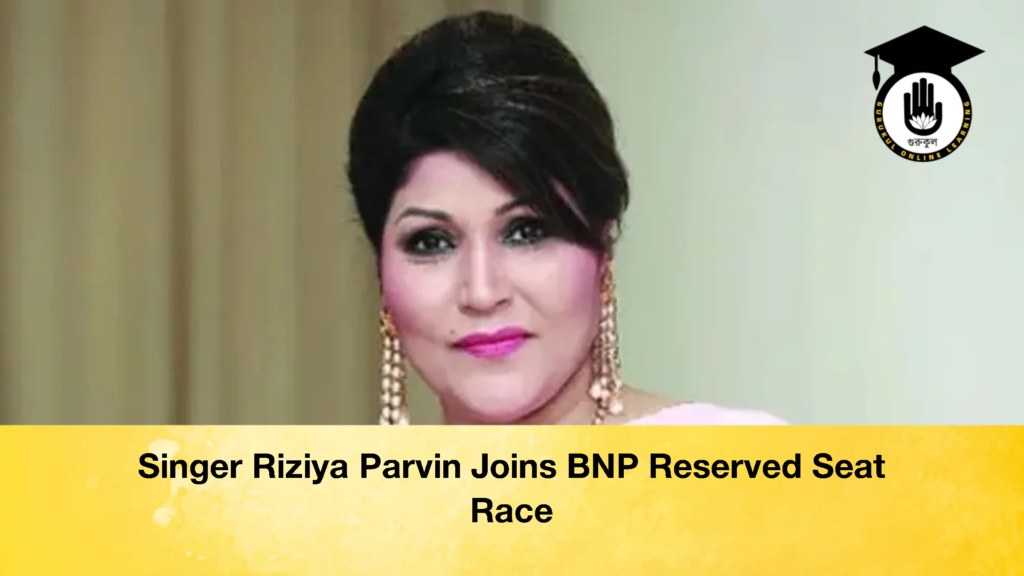
Popular Bangladeshi vocalist Riziya Parvin has formally stepped into politics after collecting nomination papers from the Bangladesh Nationalist Party (BNP) for a reserved women’s seat in the forthcoming Jatiya Sangsad elections. Her entry adds another high-profile cultural figure to the evolving intersection between Bangladesh’s entertainment industry and parliamentary politics.
The development marks a notable transition for the singer, who has spent decades in the country’s music scene and is widely recognised for her contribution to modern Bangladeshi song culture. By entering the nomination process, she is now seeking to translate her public influence into formal political representation at the national level.
Following the submission of her nomination application, Riziya Parvin addressed journalists, outlining both her motivation and policy interests. She confirmed that she has applied for a reserved women’s seat linked to her home district of Kishoreganj, stressing her desire to represent her locality while contributing to national decision-making.
“I am from Kishoreganj, and I have applied from there. I want to be elected from my own area. I want to work for women and for the people of the country,” she said, underscoring both her regional identity and broader social ambitions.
Although she has remained active in music for most of her life, Riziya Parvin said her decision to enter politics is driven by a long-standing commitment to public service. She expressed her intention to move beyond cultural performance and engage directly with policymaking, particularly on issues affecting women, marginalised communities, and rural development.
At the same time, she emphasised that her cultural identity remains central to her public life. She indicated that if elected, she would continue to advocate for the development of Bangladesh’s arts and cultural sector, which she believes requires stronger institutional support and greater policy attention.
Key Priorities Outlined by Riziya Parvin
| Focus Area | Stated Objective |
|---|---|
| Women’s rights | Strengthening empowerment, safety, and representation in governance |
| Cultural development | Expanding institutional support for arts and creative industries |
| Local development | Addressing grassroots issues in Kishoreganj and surrounding areas |
| Social welfare | Supporting vulnerable and underprivileged communities |
The singer also noted that she has already engaged in small-scale social initiatives within her locality, which she believes have helped her understand the challenges faced by rural communities more closely. She argued that such experiences have shaped her interest in more structured public service through parliamentary work.
“I want to work on women’s issues and the cultural sector. I have already done some work in my area, and if I am elected, I will give special attention to these sectors,” she added.
In Bangladesh’s parliamentary system, reserved women’s seats are allocated proportionally to political parties based on their performance in the directly elected constituencies. Parties then nominate individuals to fill these seats, often balancing internal loyalty, public appeal, and organisational considerations. The BNP is currently in the process of finalising its nominations ahead of the formation of the next parliament.
The entry of well-known cultural personalities such as Riziya Parvin into this process has generated significant public discussion. Supporters argue that figures from the arts bring visibility, communication skills, and a deeper connection with grassroots audiences. Critics, however, question whether celebrity status alone is sufficient preparation for legislative responsibilities, especially in areas requiring technical policy expertise.
Nevertheless, her candidacy reflects a broader regional trend in which artists, media personalities, and public figures increasingly transition into formal political roles, particularly through reserved or proportional representation mechanisms. This phenomenon has contributed to a more diverse parliamentary landscape, while also raising debates about the balance between popularity and policymaking competence.
As the nomination process continues, attention will remain focused on whether Riziya Parvin secures party endorsement and ultimately takes a seat in parliament. If successful, her journey from stage performance to legislative chamber will mark a significant personal and symbolic shift in Bangladesh’s evolving political-cultural landscape.