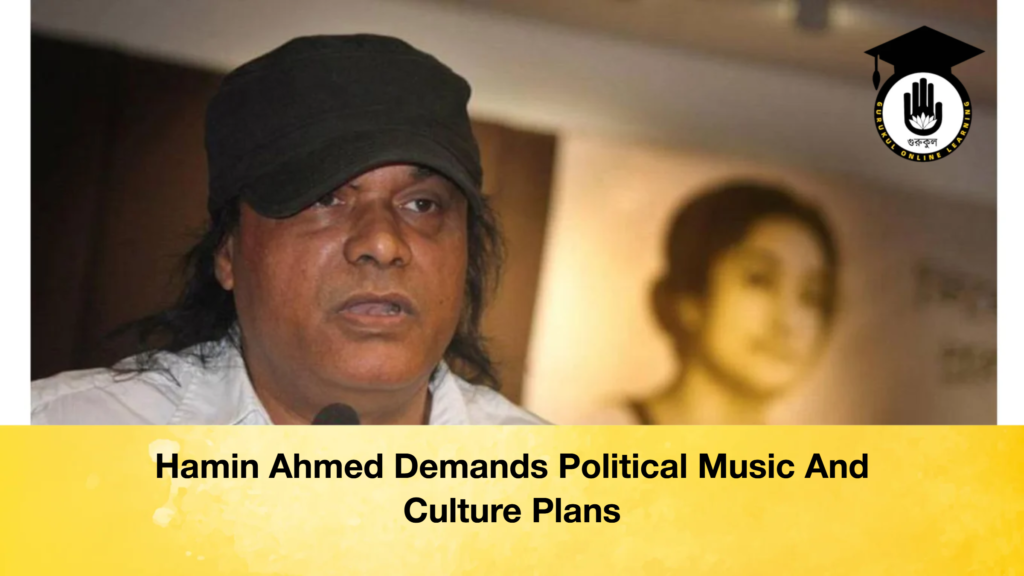
As the nation awaits the official announcement of the upcoming general election schedule, electoral preparations across Bangladesh have reached a fever pitch. Political parties are already rolling out their manifestos, outlining visions for the country’s future. Amid this charged atmosphere, Hamin Ahmed, the lead vocalist of the country’s iconic band Miles, has called upon political parties to clarify their plans regarding music and cultural development. Remarkably, he has stated that he will not support any party whose manifesto fails to address these areas positively.
Yesterday, Hamin Ahmed took to Facebook to voice his concern, writing: “The national elections are just around the corner. Musicians, creators, and music enthusiasts want to know—what are your cultural and music-based policies for the future of Bangladesh? In the country’s 54-year history, no political party has ever included concrete plans for music in their manifesto. While other sectors are addressed, music is consistently overlooked. We want to know—what is your plan for music?”
He also highlighted statistics reflecting the country’s music-loving population. According to Hamin, by 2025, approximately 28.4% of Bangladeshis listen to music via radio, podcasts, and other platforms. AI projections suggest that by 2030, this figure will reach nearly 51.91 million—roughly one-third of the nation’s population. “If such a large segment of the population collectively declares they will not vote for any anti-music party or candidate, what will happen?” he remarked. “Political parties must recognise the influence of this community.”
Hamin Ahmed’s post has quickly gone viral, circulating across multiple social media platforms. Numerous musicians, lyricists, composers, band members, and music aficionados have shared the message, lending their support.
In an interview with a leading daily, he elaborated: “For years, we have discussed this issue with fellow artists. We have noticed that while manifestos may cover a wide range of topics, they never include music or arts strategies. Yet, at public events, when music is absent, musicians are repeatedly sidelined. Now, we want to know—what are the cultural and artistic strategies of the parties contesting the elections? So far, no party has made a clear statement.”
Hamin Ahmed further cautioned: “In recent times, there have been numerous conspiratorial and confusing incidents affecting music and culture in the country. Shows have been cancelled, and performers have been asked to halt music at times. We are not lodging complaints against anyone, but we seek clarity—how will the parties participating in the elections uphold and advance our musical and cultural rights?”