
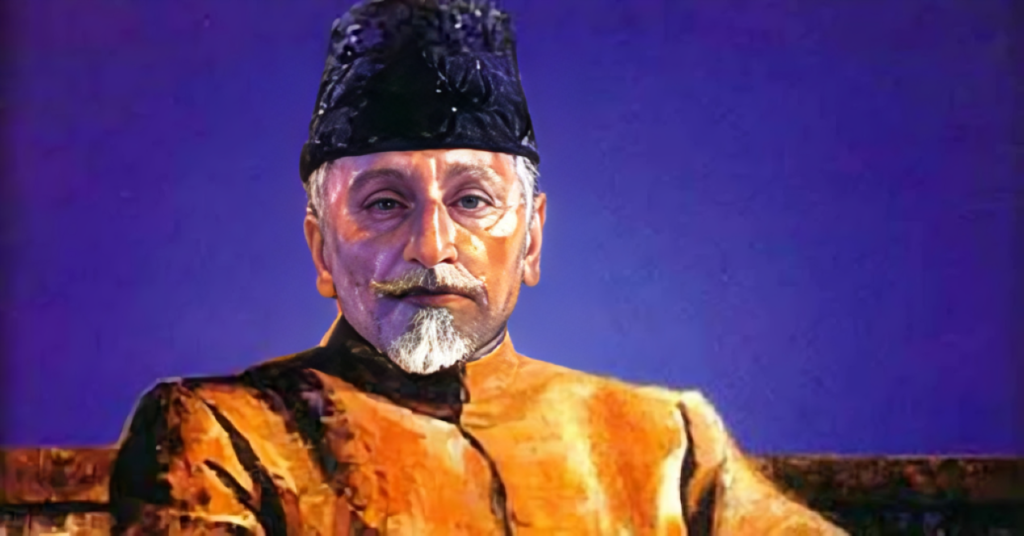
Maulana Abul Kalam Azad (11 November 1888 – 22 February 1958) was one of the most versatile intellectuals of modern India—a political leader, Islamic scholar, philosopher, polyglot, and literary craftsman. Beyond his public identity as a freedom fighter and educationist, Azad possessed an extraordinary aesthetic sensibility in which music occupied a special and intimate place. His reflections on music are expressed most richly in his celebrated Urdu prose work Ghubar-e-Khatir (غبارِ خاطر), a book he wrote during his imprisonment in Ahmednagar Fort from 1942 to 1946. These writings, composed as letters to a close friend but never posted due to prison restrictions, offer the most profound insight into Azad’s emotional and artistic world. Among the many subjects he covers—religion, philosophy, nature, literature, history—music emerges as one of the most revealing themes, shedding light on the subtler layers of his personality.
In Ghubar-e-Khatir, Azad approaches music as a universal human expression embedded in the deepest instincts of humanity. He speculates on the origins of music, tracing it to emotional impulses, childlike utterances, birdsong, and ritual chant, arguing that music is not an artificial construct but a natural extension of human feeling. Through the imagery of birds—especially the nightingale (bulbul), a motif he inherited from Persian poetic tradition—Azad suggests that the human longing communicated through music is identical to the longing encoded in nature. Music, in his understanding, becomes a bridge between the seen and the unseen, the temporal and the eternal, the human and the divine.
Azad’s religious training enabled him to understand the long theological debates about the permissibility of music in Islam. However, instead of taking a rigid doctrinal stance, he responds with a balanced, humanistic perspective. He acknowledges the arguments on both sides but emphasizes that music should be understood in terms of its effect on the human spirit. If music elevates, refines, softens, and enriches emotional life, then, according to Azad, it aligns with the deeper ethical objectives of religion. Rather than treating music as a matter of law, he presents it as a matter of inner cultivation. In this way, his reflections offer an enlightened, compassionate, and historically grounded approach that continues to resonate with scholars of religious aesthetics.
Music also figures prominently in Azad’s personal emotional landscape. Throughout the letters, music becomes a companion to solitude, especially during his long confinement. The silence of prison provides the background against which imagined melodies acquire greater intensity. He often describes the subtle effects of sound—the whisper of wind, the rhythm of tea boiling, the song of a distant bird—revealing how music, in its broadest sense, becomes a medium through which he preserves his emotional equilibrium. His sensitivity to rhythm and melody, even in these small, ordinary sounds, highlights the depth of his aesthetic awareness.
To understand how music fits into the broader landscape of Ghubar-e-Khatir, it is important to examine the structure of the book itself. Although editions differ in the exact presentation of headings, the work consists of twenty-four letters, each functioning as a self-contained essay. These letters range across Azad’s daily routines in prison, his philosophical reflections on God, his commentary on literature, his memories of friends and travel, his observations of nature, and his thoughts on culture and history. Azad’s linguistic style is a blend of refined Urdu prose and abundant quotations from Persian and Arabic poetry—over five hundred couplets are interwoven throughout the book. His prose is at once conversational and erudite, capable of moving effortlessly from a meditation on the making of tea to a philosophical disquisition on aesthetics.
Among these diverse themes, music emerges repeatedly as an anchor. The sections concerning the nightingale and the crow, for example, are not merely anecdotes but reflections on how sound conveys meaning. Azad uses these stories to explore the psychology of listening and the delicate distinctions between noise, sound, and music. His discussions of melody and emotional response are shaped by deep literary knowledge and a refined philosophical outlook. This aesthetic treatment of music is one of the reasons Ghubar-e-Khatir continues to be studied by scholars interested in music, culture, and religion in South Asia.
The book has been widely circulated since its first publication shortly after Azad’s release in 1946. It has been reprinted in various Urdu editions—by publishers such as Hali Publishing House in Delhi and Maktaba-e-Rashidiya in Karachi—and many digitized versions are now available on Archive.org and the Digital Library of India. The authoritative English translation, titled Sallies of Mind, was published in 2003 by the Maulana Abul Kalam Azad Institute of Asian Studies in collaboration with Shipra Publications. This translation has introduced the work to a wider global readership and remains the standard reference for non-Urdu readers. Parts of the work have also appeared in Hindi and Bengali translations, though the English one remains the most comprehensive.
Scholars of South Asian literature and intellectual history often describe Ghubar-e-Khatir as one of the finest achievements of modern Urdu prose. Literary critics see it as a work that fuses introspection, philosophical depth, and elegant spontaneity. Historians view it as an exceptional prison narrative in which a confined thinker transforms the constraints of isolation into fertile ground for reflection. Students of religion appreciate its moderate, thoughtful approach to questions of faith and culture. And among musicologists, Azad’s reflections are frequently cited as an example of how a religious scholar can engage with music not defensively but through a deep cultural and psychological understanding.
Ultimately, Maulana Azad’s relationship with music reveals a dimension of his personality that complements his intellectual and political stature. His writings show that he saw music not simply as an art form but as a metaphor for human existence—an interplay of harmony and discord, a movement between longing and fulfillment, a search for beauty even in solitude. Music, for Azad, embodied the possibility of inner freedom at a time when outer freedom was denied to him. Through Ghubar-e-Khatir, he left behind not only a masterpiece of literature but also one of the most eloquent meditations on music ever written by a modern South Asian thinker.