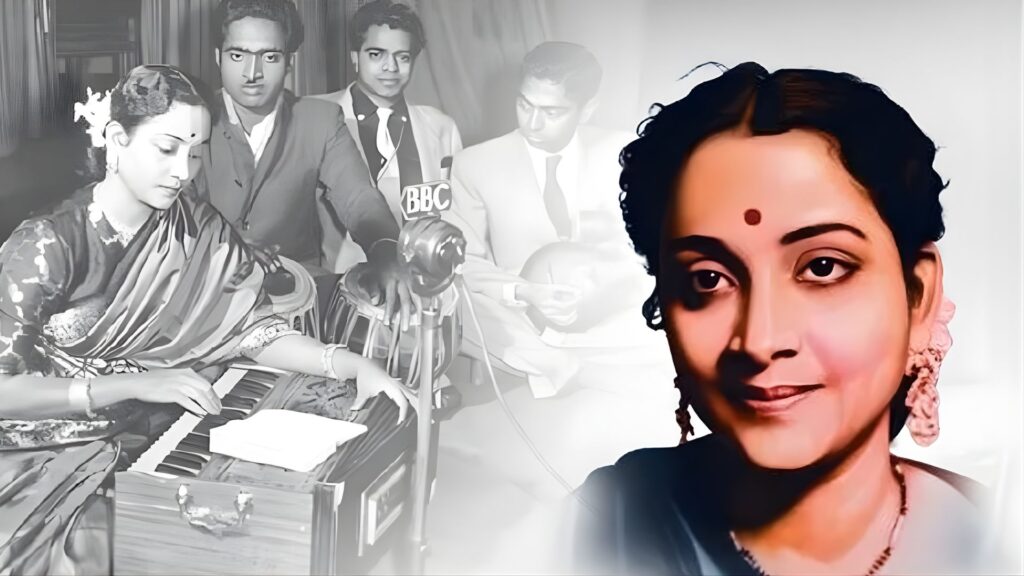
She was the immortal voice behind “Tumi Je Amar”, “Ei Shundor Shornali Shondhya”, “Nishi Raate Banka Chand Akash”, “Mera Naam Chin Chin Chu” and “Babuji Dheere Chalna”. Yet few realise that this legendary figure of the Bombay film world was, in fact, born on Bangladeshi soil. On her birthday, the world remembers Geeta Dutt—one of the most distinctive playback voices of South Asian cinema and the life partner of actor-director Guru Dutt.
Geeta Dutt’s brilliance defies easy description. Even composer Hemanta Mukherjee once struggled for the right superlative. While preparing the soundtrack for Harano Sur, he was convinced that “Tumi Je Amar”—originally thought suited to Sandhya Mukherjee—required only one voice. It had to be Geeta. The recording took place in Bombay, and the outcome became historic. To this day, profiles on Suchitra Sen almost unfailingly begin with a reference to this very song, so seamlessly did Geeta’s voice merge with the on-screen persona.
A popular saying in India’s music world long held: Lata’s style may be emulated, Asha’s tone may be mimicked, but no one can replicate the voice of Geeta Dutt.
Table of Contents
A daughter of Faridpur
Born on 23 November 1930 in Faridpur, Bangladesh, as Geeta Ghosh Roy Chowdhury, she grew up in a zamindar household. Her parents recognised her musical inclination early and arranged lessons with local teacher Harendranath Nandi. But political change and financial strain forced the family to move—first to Kolkata and Assam, and finally in 1942 to Bombay.
Unable to afford further training, young Geeta continued to practise on her own while giving music lessons to help the family. She walked long distances to save bus fare and was often made to sit on the floor in the homes where she taught. Fate intervened when Pandit Hanuman Prasad overheard her singing from a balcony and immediately recognised her extraordinary gift. Under his guidance she entered films at sixteen, singing two chorus lines in Bhakt Prahlad (1946).
Meteoric rise
Her brief part in Bhakt Prahlad caught the attention of composer S. D. Burman, who cast her as the principal voice in Do Bhai. Despite warnings against using an “inexperienced” newcomer, Burman remained firm. His faith paid off. “Mera Sundar Sapna Beet Gaya”, sung with aching poignancy, turned the young Geeta into a phenomenon. Between 1947 and 1949 she became one of India’s top three female playback singers, distinguished by her emotive delivery, Bengali intonation and versatility across devotional songs, romantic melodies and Western-influenced club numbers.
Marriage, conflict and artistic restraint
Her life changed course again after meeting director Guru Dutt during the recording of Baazi in 1951. A three-year romance culminated in their marriage in 1953, when Geeta Ghosh became Geeta Dutt. Guru Dutt, however, preferred that she sing exclusively for his productions, narrowing her professional space. Yet even within that limited scope she delivered iconic numbers such as “Aye Dil Hai Mushkil Jeena Yahan”, “Babuji Dheere Chalna”, “Thandi Hawa Kali Ghata” and “Na Jao Saiyan”.
Personal turmoil
By the late 1950s, tensions in the marriage deepened. Guru Dutt’s growing rapport with Waheeda Rehman became the subject of intense industry gossip. Films faltered, quarrels escalated, and the couple eventually began living apart. Guru Dutt died in 1964, an event that devastated Geeta.
She attempted to revive her career, even acting in the Bengali film Badhubaran, but the industry had changed. Lata Mangeshkar and Asha Bhosle now dominated the playback landscape. Though her songs in Anubhav were critically acclaimed, a severe liver condition—cirrhosis—cut short her recovery.
Her final years were spent between painful hospital treatments and sporadic recording sessions, where critics marvelled at how she still delivered expressive, delicate performances despite extreme physical suffering. On 20 July 1972, Geeta Dutt passed away, leaving behind a legacy that remains unmatched.
It is said that S. D. Burman once reserved the song “Banshi Shune Ar Kaj Nai” especially for her. Although she never sang it, the loss of hearing it in her voice remains a lasting regret for lovers of Bengali music.