
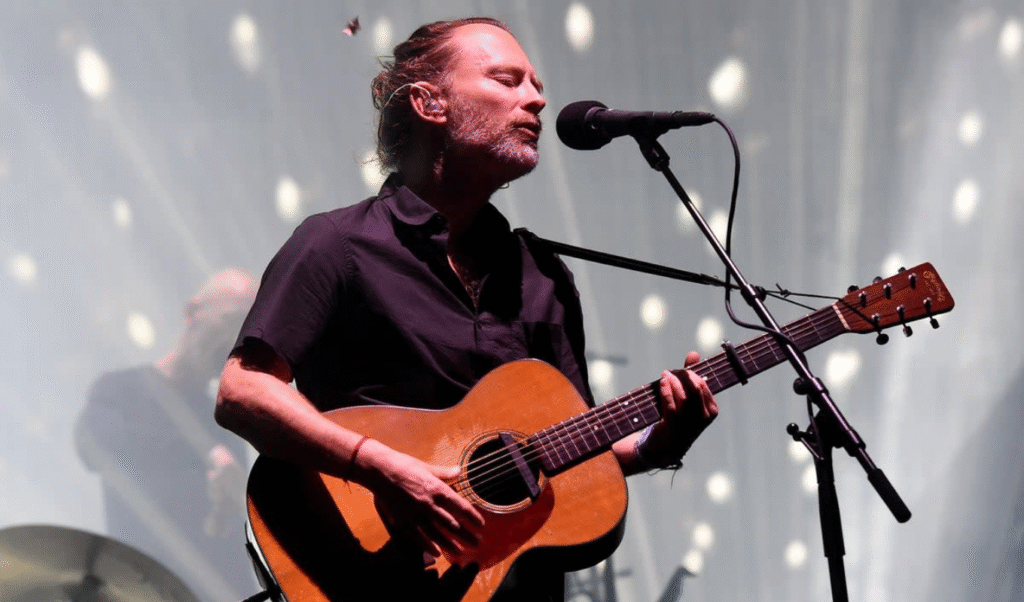
Four decades since five schoolboys first formed a band, over 20,000 fans gather in the O2 Arena on a Friday night to witness Radiohead’s return to the stage. Tickets for this tour sold out in minutes, and as the band’s records continue to top charts, it’s clear that the connection between Radiohead and their devoted fanbase runs deep. But what makes this band, whose music often explores themes of alienation, so enduringly magnetic?
The answer is present right in front of me, as the band plays “in the round,” with the members positioned around a circular stage: Phil Selway behind his drum kit in the centre, Ed O’Brien to the left, Thom Yorke wandering around, Jonny Greenwood to the right with a dizzying array of instruments, and Colin Greenwood further back with his bass. Chris Vatalaro joins as a second drummer, adding another layer to the performance.
The show opens with the glitchy, distorted chords of “Planet Telex,” followed by the glorious drop into Yorke’s haunting vocals. The atmosphere is electric, filled with anticipation, joy, and nerves—a sensation I’ve felt each time I’ve seen Radiohead since first hearing “Paranoid Android” on the school bus in 1996.
Watching Jonny Greenwood flit between instruments—ondes Martenot, synthesizers, guitars—while Selway’s drumming blurs into a blur of motion, I’m reminded of how extraordinary each band member is. Even without fully seeing Colin, his intricate basslines pulse through the arena, adding depth to the performance. Radiohead’s technical prowess is matched by the joy they exude as they smile, interact with one another, and engage with the crowd.
Table of Contents
Radiohead’s Alienation: A Comfort in Its Familiarity
Despite frequent criticisms of Radiohead’s music as “depressing,” the band’s sound is not merely bleak—it’s uplifting in its honesty. Their lyrics address existential alienation, political frustration, and personal confusion, offering a raw glimpse into the complexities of life. In fact, their music about alienation makes the experience of feeling alienated feel strangely less isolating.
Radiohead’s lyrics speak to the sense of disorientation I felt as a teenager, and now as I approach middle age, their themes of uncertainty and chaos resonate even more deeply. Their music holds space for that feeling of confusion, and, in doing so, makes it easier to accept and process. The Bends and OK Computer became milestones in my own journey, offering a soundtrack to life’s transitions and struggles. Radiohead’s ability to keep me engaged through all their musical shifts and thematic explorations is why their songs have such staying power.
Live Performance: Unpredictable and Thrilling
One of the most exhilarating aspects of a Radiohead show is its unpredictability. You never quite know what to expect—whether Jonny Greenwood will pick up a new instrument or how the percussion might evolve. The band’s live performance often bends and reshapes the songs, keeping fans on their toes. Their ability to subvert expectations and experiment with different tonal shifts makes each show unique, even when playing familiar tracks.
Their use of pivot tones—core harmonies or chords from which they venture out and return—mirrors how Radiohead themselves evolve over time, constantly pushing boundaries but always returning to their musical roots. It’s as if their albums and live shows are a reflection of life’s cyclical nature, reminding us that, like the band, we too can step away and return to our core beliefs.
Personal Reflection: Rediscovering the Buzz
Watching Everything In Its Right Place, I feel a strange sense of relief. Nine years ago, after the birth of my first child, I found that my obsession with music faded. It was as if that part of my brain was reprogrammed. I’d heard of other new parents experiencing the same loss of musical connection. But as the night unfolds, I realise that the magic is still there. The buzz that once coursed through me at live shows is back. This may be my favourite Radiohead performance yet, and I’m grateful to feel that familiar spark once again.
A Remarkable Encore
Radiohead’s encore is a musical feast, filled with some of their most beloved tracks. “You and Whose Army?” feels ethereal, while “Paranoid Android” brings the crowd into a frenzy with its complex rhythms and haunting melodies. The closing track, “Karma Police,” takes me back to when I first heard it in a friend’s bedroom, struck by its emotional impact.
Thom Yorke’s rare flashes of humour—like the way he calls for the crowd to settle down—are a reminder of how far Radiohead have come since their early days. It’s been 10 years since their last new album and almost nine since their last UK show, making their return all the more significant.
A Band in Transition
Despite the absence of new material, the band’s return to the stage signals a period of renewal. They’ve rehearsed a staggering 65 songs, sifting through their entire discography. Their set includes a mix of crowd-pleasers from their 90s era, such as “Fake Plastic Trees” and “Let Down,” along with more recent gems from A Moon Shaped Pool. The performance is a testament to their enduring artistry, even as they navigate changes in their personal lives and band dynamics.
With no new material on the horizon, Radiohead’s reunion tour feels more like a personal journey than a commercial one. There are whispers of internal tensions and personal struggles, but their ability to reconnect as a band—and with their audience—is undeniable. As Thom Yorke said, “We haven’t thought past the tour.” Whether this marks the beginning of a new chapter for Radiohead or simply a one-off return, their fans are hoping this moment will lead to something more—perhaps even a full-fledged comeback.
For now, as the crowd files out, singing “Karma Police,” we can all agree that, for tonight at least, everything is in its right place.