“Are you ready, Shanghai?!” shouted the DJ, his glowing booth at the heart of a spectacular, pulsating display of colour and sound.Thousands of fans roared back, “Yes!” as Tomorrowland, one of the world’s biggest electronic dance music festivals, made its debut in China this weekend.
This event marks a significant bet on China’s emerging but enthusiastic electronic dance music (EDM) scene, with Tomorrowland hoping to tap into a market with strong potential despite slower consumer demand in other sectors of the economy.
Tomorrowland, renowned for its star-studded line-ups and cutting-edge stage production, has become a bucket-list event for serious EDM fans. “For me, Tomorrowland is a dream,” said Mark, a Chinese EDM fan sporting sunglasses and a bright yellow arrow headdress. While EDM has been “relatively niche” in China, he believes the scene is expanding. “Over the last decade, it’s really taken off. Now, even my parents are starting to learn about EDM,” he said.
Cameron Sunkel, of specialist site EDM.com, suggests that China offers the steepest growth curve for the EDM market. He pointed out that in more established markets, such as Europe and the US, rising production costs limit growth, but China’s youthful, urban middle class is eager to “premium-ise” its party experiences. “China is where the demand is strongest for this type of experience,” he said.
A spokeswoman for Tomorrowland expressed confidence in China’s long-term prospects, comparing the market to Brazil, where Tomorrowland has been hosting festivals since 2015. “When we first arrived, it was also a niche market. Today, we see a rapidly growing community and incredible local talent,” she said.
Indoor Festival Draws Attention
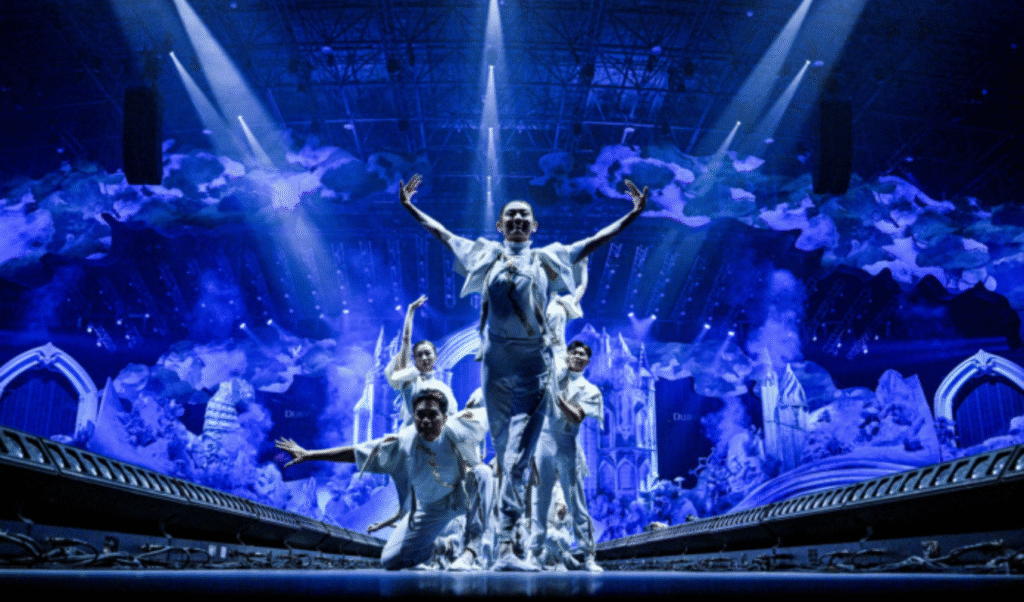
The Shanghai event, titled The Magic of Tomorrowland, marked the festival’s first indoor edition. Upon entering the venue, attendees were stunned by the towering, castle-like stage, with a 374-square-metre video wall behind it. At a second stage, dancers screamed as confetti cannons exploded and a bass drop shook the crowd, with glitter raining down like a shimmering storm.
While China’s economy has been sluggish, the youth market is spending more on “emotional consumption” — experiences that make them feel good. A recent industry report revealed that ticket revenue from large- and medium-sized concerts and festivals in China grew by 66.5% in 2024, reaching nearly $4.2 billion.
Major festivals like Ultra and Creamfields have also hosted editions in China, but the momentum was disrupted during the pandemic. Grace, a 29-year-old Chinese influencer in hot-pink flares, reflected on the decline of EDM bars in Shanghai. “Ten years ago, there were many EDM bars, but now there are fewer,” she said. “So it’s exciting for a big brand like Tomorrowland to come to China.”
A Tightly Managed Event
The Shanghai event was small compared to Tomorrowland’s massive Belgian festival, which drew 400,000 attendees across two weekends this year. The Chinese edition had a 10,000-person capacity, and the festival partnered with local entertainment companies Hero Esports and INS Land, as well as local authorities keen to boost the city’s international appeal.
The purpose-built main stage was completed in just five months and featured over a thousand moving lights, 118 speakers, and numerous lasers, smoke machines, and bubble effects. Jay Lu, Hero Esports’ event marketing chief, explained that the event was designed to offer “a fairy tale, an entire experience.”
Sunkel from EDM.com noted that the indoor setting allowed Tomorrowland to test its brand in China under “tightly managed conditions.” As is typical for such events in China, there was a visible security presence, and the final performance, featuring global star Dimitri Vegas alongside Chinese rapper Masiwei, ended promptly at 10 pm.
Some European attendees found the bar system limiting, as each person was restricted to just two alcoholic drinks.
While organisers declined to disclose the event’s financial details, Clinton Lau, CEO of Hero Esports, expressed optimism for the long-term partnership. “We’re excited to educate the Chinese community about EDM and raise the bar for the industry,” he said.
When asked if this year would turn a profit, Lau smiled. “Building something this grand takes time for the market to mature,” he said.
By Rebecca Bailey