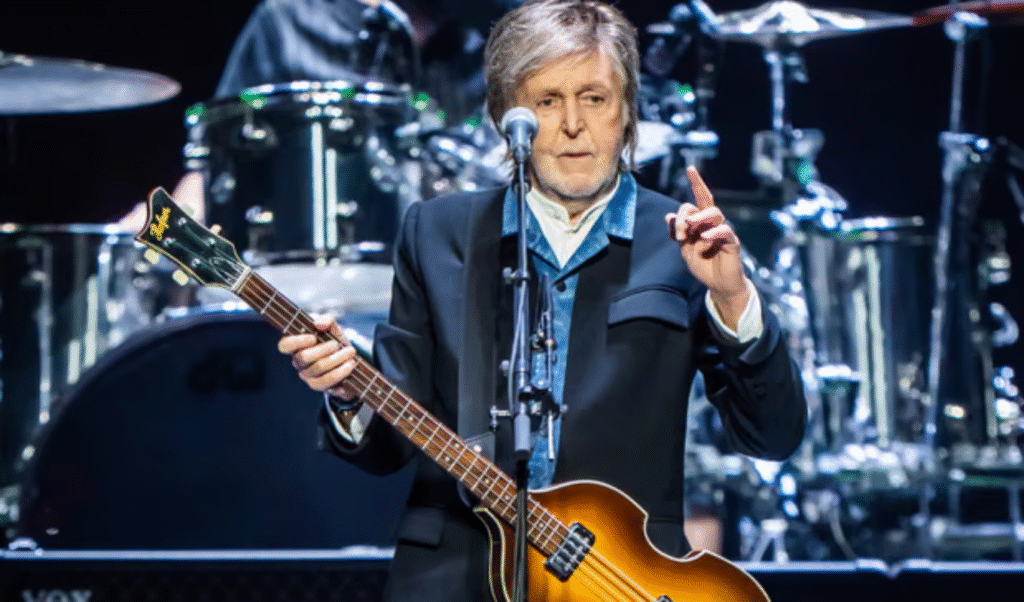
Paul McCartney has released a new track as part of a music industry protest against the exploitation of musicians’ intellectual property by artificial intelligence (AI) companies. The track, which comes as McCartney’s first new recording in five years, is notably absent of the catchy melodies and lyrics he is known for. Instead, the nearly three-minute piece features almost complete silence, save for quiet tape hiss and occasional clattering sounds.
The 83-year-old former Beatle’s contribution, titled [bonus track], serves as a stark commentary on the growing concerns within the music industry about AI companies using copyrighted material to train their generative models without consent or compensation. McCartney’s track is featured on the B-side of an album titled Is This What We Want?, which consists entirely of silent recordings. The album will be released on vinyl later this month.
The silent track is McCartney’s creative protest against AI’s potential to undermine the music industry and the livelihoods of songwriters and performers. The piece begins with 55 seconds of tape hiss, followed by 15 seconds of indeterminate clattering, and concludes with 80 seconds of rustle-punctuated silence, fading slowly to an end.
A Call for Action Against AI Copyright Exploitation
This release comes as part of a broader movement within the music industry, with artists calling on the UK government to stop technology companies from using their creative output to train AI models without permission. The album’s track listing explicitly states: “The British government must not legalise music theft to benefit AI companies.”
Ed Newton-Rex, a composer and advocate for copyright fairness, has expressed concern that the government is prioritising the interests of US tech giants over those of British creatives. Other prominent musicians supporting the campaign include Sam Fender, Kate Bush, Hans Zimmer, and the Pet Shop Boys.
McCartney himself has voiced his worries about the impact AI could have on young composers and songwriters. In a recent interview, he stated: “We’ve got to be careful about it because it could just take over. If AI wipes out young composers, that would be a very sad thing indeed.”
A Debate on the Future of AI and Copyright
The UK government is currently consulting on potential changes to copyright law to allow “text and data mining,” which would enable AI companies to access vast amounts of data, including music, to train their models. However, these changes could require copyright holders to actively opt out of their work being used in this way, raising concerns about the fairness of such a system.
The issue is further complicated by international pressure from figures like Donald Trump, who has argued that AI companies should be allowed to use copyrighted material freely. Trump has warned governments not to impose regulations that would hinder AI development, claiming that such rules would make it difficult for AI companies to do business.
Meanwhile, Beeban Kidron, a cross-bench peer and film director who campaigns for copyright protection, accused the government of failing to support creators. She stated: “The government is trying to play both sides and convincing neither. They have proven themselves unfit to govern in the economic interests of the creators.”
The UK government has responded by emphasising its commitment to working with both the creative industries and AI companies to ensure innovation while protecting creators’ rights. However, concerns remain that the interests of the music industry could be sidelined in favour of tech companies pushing for looser regulations.
As the debate over AI’s role in the creative industries continues, McCartney’s silent track serves as a bold statement about the future of music and the need to protect the rights of artists.