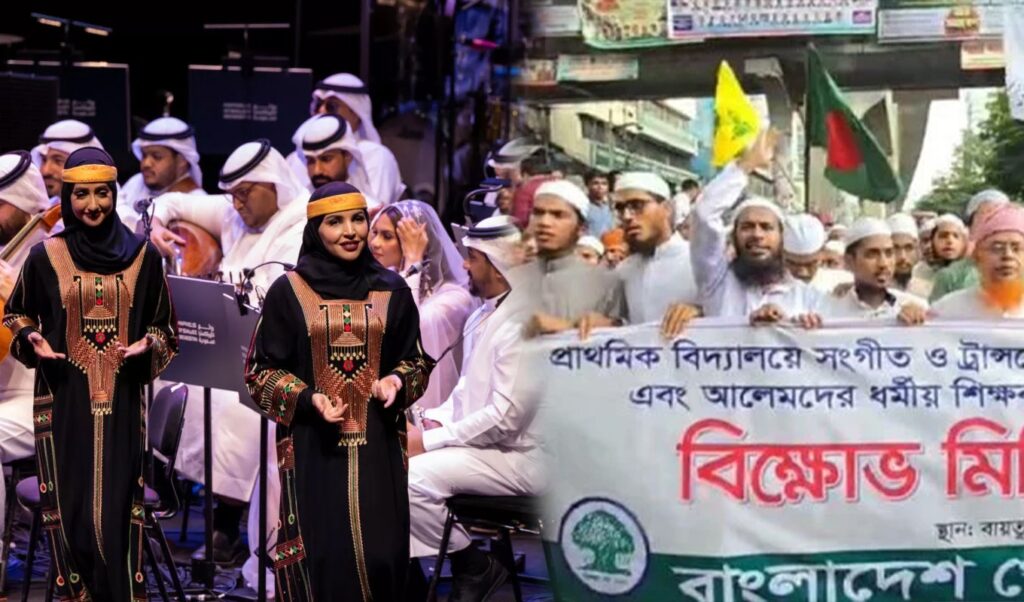
In an age of rapid social transformation, the contrast between Saudi Arabia and Bangladesh over the issue of music education presents a striking paradox. The country that once banned concerts, cinemas, and even women’s participation in cultural events — Saudi Arabia — is now hiring music teachers in its schools.
Meanwhile, Bangladesh, one of the largest Muslim-majority nations, has withdrawn its plan to appoint music and physical education teachers in primary schools after pressure from Islamist groups — despite proudly describing itself as a secular republic.
Two Muslim-majority nations — one marching towards enlightenment, the other retreating under the weight of old conservatism.
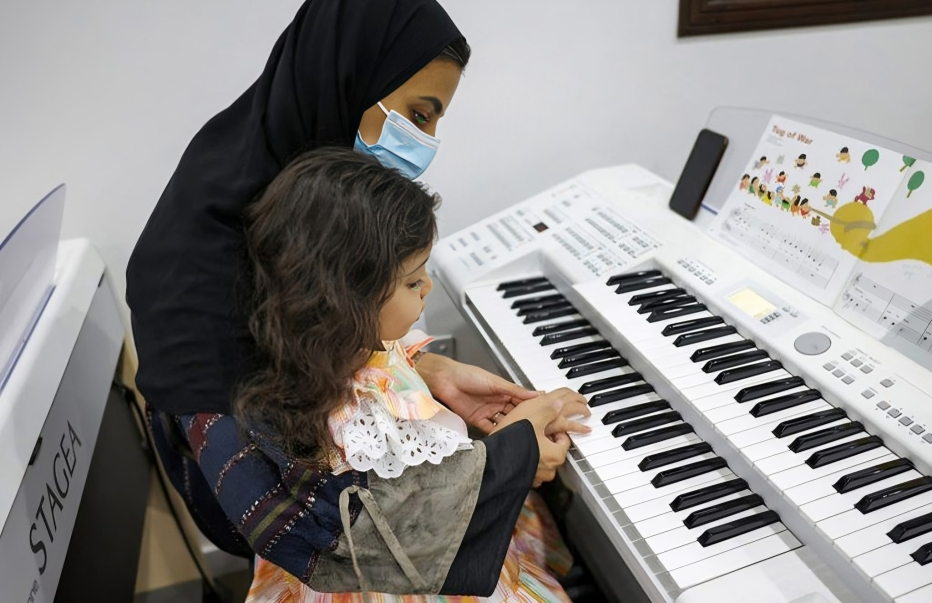
Table of Contents
Music in Saudi Arabia: From Prohibition to a Cultural Renaissance
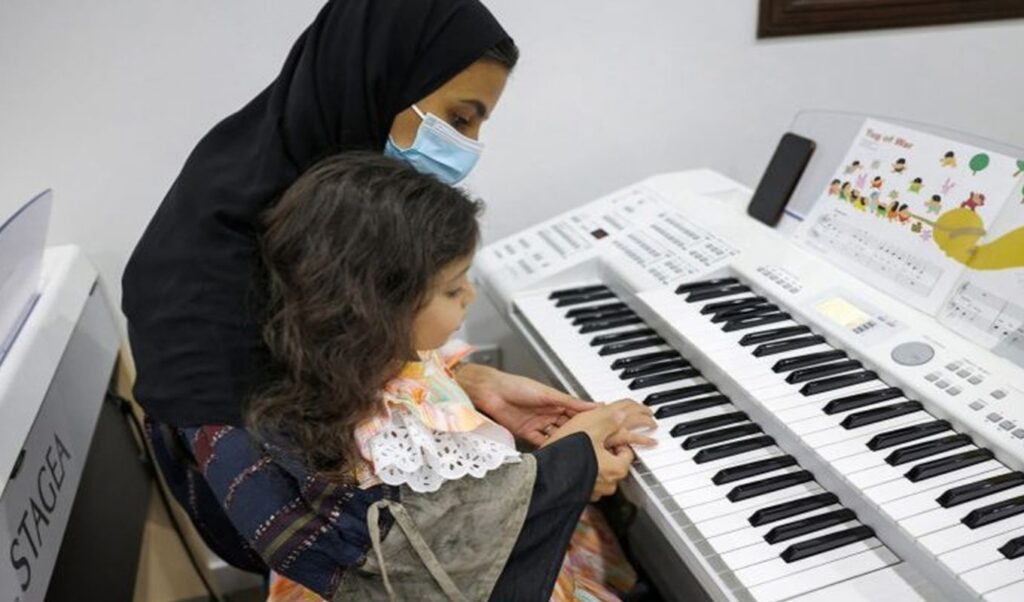
The Saudi government has recently taken a historic step by introducing music education into the country’s school system.
This initiative is part of a broader plan to promote the arts and culture, aimed at familiarising children with music from an early age and cultivating creative talent over time.
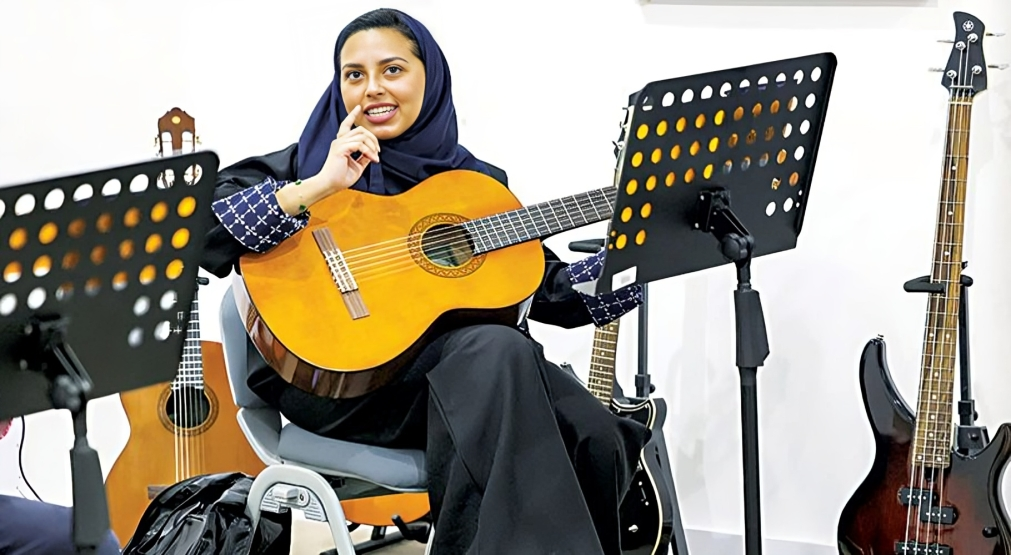
A joint programme between the Ministry of Education and the Ministry of Culture, the project primarily focuses on training female teachers in music.
In its first phase, launched in 2022, more than 12,000 female teachers from public and private kindergartens received music training.
The second phase, now underway, will train a further 17,000 women in rhythm, singing, musical instruments, and local folk traditions.
This training initiative forms part of the government’s “Cultural Competence Development Strategy,” designed to foster creativity, emotional expression, and cultural awareness among children.
Teachers will now conduct lessons in singing, rhythm, and basic music theory, integrating art and culture into early childhood education.
In 2023, King Saud University in Riyadh established the nation’s first College of Arts, offering higher education and research in music and fine arts.
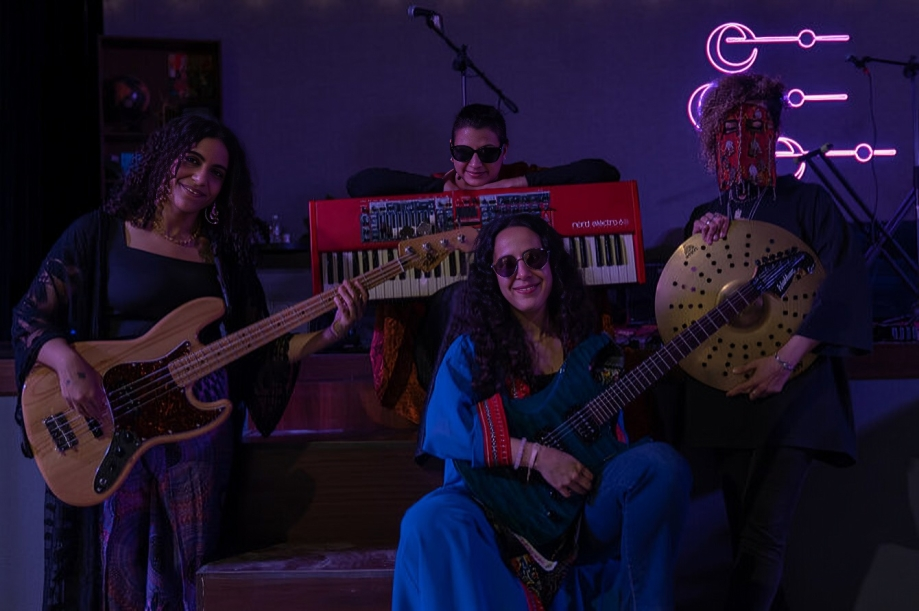
Meanwhile, the Music Commission, formed in 2020 under the Ministry of Culture, continues to ensure equal access to music education, nurture young talent, and embed music as a recognised component of Saudi Arabia’s economy and social life.
In recent years, Saudi society has witnessed a profound cultural shift.
Concerts, theatre festivals, film screenings, and artistic events are now held regularly across the kingdom.
What was once labelled “haram” (forbidden) has now become a symbol of Saudi Arabia’s social reawakening and modern identity.
Bangladesh: Retreating from Modern Education under Religious Pressure
While Saudi Arabia moves forward with music education, Bangladesh appears to be turning back the clock.
In August 2025, the government of Bangladesh issued the “Government Primary School Teacher Recruitment Rules 2025”, which included provisions for appointing teachers in music and physical education.
But within days, the Ministry of Primary and Mass Education released a revised gazette, quietly removing the posts of music and sports teachers.
This abrupt reversal sparked nationwide controversy.
Several religious organisations and Islamist political groups opposed the inclusion of music teachers, demanding instead that religious teachers be appointed.
Protests, public demonstrations, and statements from clerics quickly followed, and ultimately, the government bowed to the pressure and withdrew its earlier decision.
In an official explanation, the government stated:
“Appointing such a small number of teachers will not yield any meaningful result at the primary level and may create inequality.”
However, many education experts dismissed this reasoning as a political excuse.
They believe that the government succumbed to pressure from religious quarters, setting a dangerous precedent for future educational reforms.
The Adviser on Religious Affairs, Dr A.F.M. Khalid Hossain, admitted in a BBC interview that he had recommended including qualified Qawmi madrasa graduates in primary teaching positions.
Meanwhile, the ministry’s adviser, Professor Bidhan Ranjan Roy Poddar, declined to comment.
Educationists widely see this as a significant setback for Bangladesh’s secular education system.

Two Contrasting Realities: Religion, Culture, and Conflict
Here lies the central irony.
The nation once regarded as the epicentre of Islamic conservatism, Saudi Arabia, is now teaching music in schools.
Meanwhile, Bangladesh — a country that proudly claims a secular identity — has abandoned music education in the face of religious opposition.
Analysts note that:
“Where Saudi Arabia embraces modernity under the banner of religious reform, Bangladesh is surrendering to religious conservatism.”
Crown Prince Mohammed bin Salman has repeatedly declared that Saudi Arabia must move beyond “extremist interpretations” to survive and thrive in the modern world.
Bangladesh, however, stands at a crossroads — torn between its secular constitution and the growing influence of religious politics.
Educators’ Views: Culture as the Measure of Progress
Scholars in both Dhaka and Riyadh agree on one thing — cultural education is an essential indicator of national progress.
Bangladeshi academic Professor Anisuzzaman Chowdhury commented:
“Music, art, and sports are not luxuries; they are vital elements of a child’s emotional and intellectual development. To reject them in the name of religion is to deny children a complete education.”
A senior official of Saudi Arabia’s Music Commission expressed a similar sentiment:
“We are not westernising Saudi culture; we are enriching it. Music is not a sin — ignorance is.”
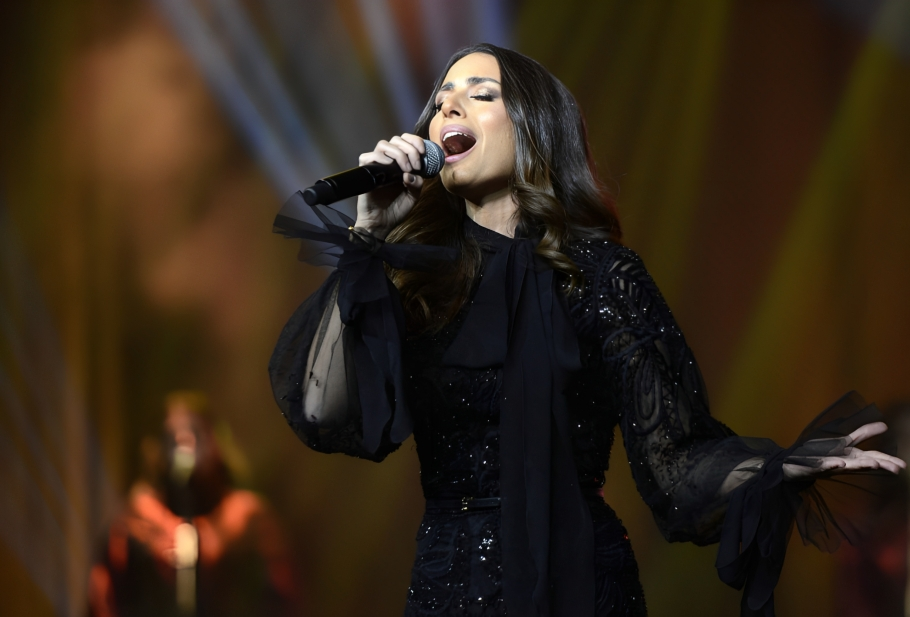
A Tale of Two Nations: The Divide Between Culture and Courage
The comparison between these two nations reveals the current psychological divide within the Muslim world.
One society is embracing modern reform through culture, while another remains trapped in the fear of religious backlash.
Saudi Arabia today recognises music and the arts as instruments of national reform,
while Bangladesh — the land of Tagore and Lalon, where music once embodied the soul of the nation — continues to treat it as something forbidden.
Thus emerges a poignant paradox:
What is permissible in Saudi Arabia is forbidden in Bangladesh.
The Broader Question
This debate over music education raises a profound question:
How does a nation measure its progress — through fear or through freedom of thought?
In Saudi Arabia, music has become a symbol of transformation.
In Bangladesh, it has become a symbol of controversy.
And the question still lingers:
If the guardian of Islam, Saudi Arabia, can teach music to its children, why can’t a secular Muslim democracy do the same?