
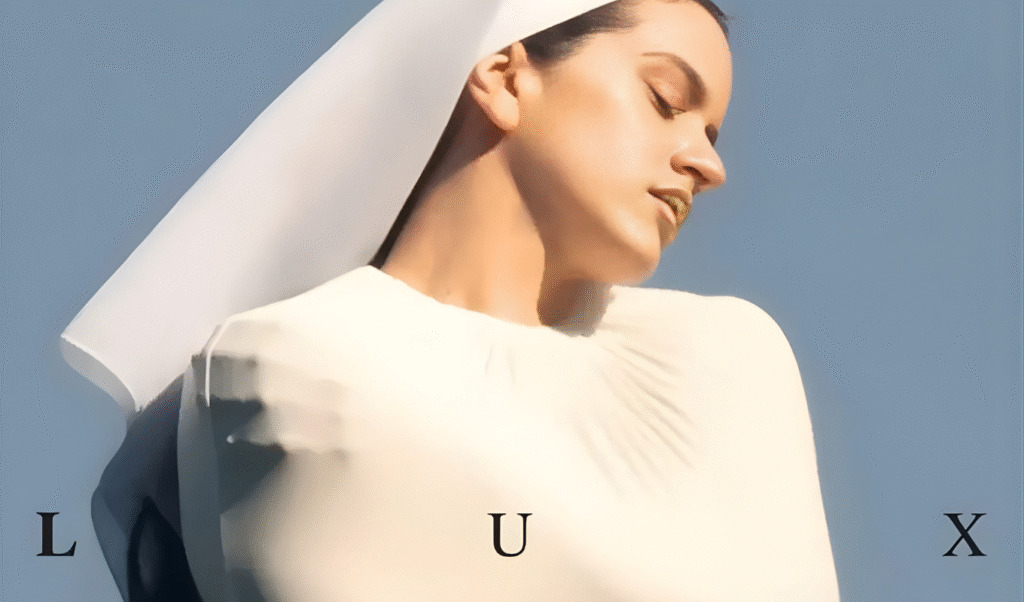
Rosalía ascends into LUX like a divine revelation, with the Spanish singer and producer’s latest album unfolding across four movements that push the boundaries of her artistry. In this ambitious project, she reinvents her sound, taking her place as both a performer and a visionary architect of modern pop.
Throughout her career, Rosalía has consistently drawn inspiration from centuries-old art forms, transforming them into something refreshingly contemporary. This has earned her critical acclaim and a growing global following.
In 2017, Rosalía emerged as a disruptor in the world of flamenco with her debut album Los Ángeles, deconstructing the genre’s intricate styles into a narrative-driven pop format. Then, in 2018, her breakthrough album El Mal Querer blended flamenco’s traditional elements with R&B production, winning the Latin Grammy Award for Album of the Year in 2019. If El Mal Querer was about translation — turning flamenco into a pop language — then LUX is about the feminine mystique and transcendence, exploring realms beyond language itself. This shift marks the most significant departure in her discography, pushing pop towards ritualistic structures across 18 tracks.
As Rosalía explains in a Popcast interview, each album aims to bring her “closer to God”. With LUX, she uses orchestral flourishes and minimalistic, intimate production to centre her voice, making it the focal point of this sweeping sonic exploration. Singing in 13 languages, including Latin, Catalan, English, German, and Ukrainian, Rosalía blends them into a seamless flow. Rather than simply showcasing divine expression, language becomes texture, and her voice acts as an instrument, shifting to convey emotional purity. Rosalía invites listeners to interpret the album in their own way, describing it as a “choose-your-own-adventure” experience.
Pop Beatification
The first movement of LUX, with its themes of sex, regret, and revenge, begins quietly. “Porcelana” stands out with its minimalist, almost Brutalist production, allowing Rosalía’s unguarded melodies to take centre stage.
Lyrically, Rosalía pushes herself to the limit, exploring themes of the body as a religious relic in tracks like “Divinize”. Lines such as “Each vertebra reveals a mystery / Pray on my spine it’s a rosary” show her fearless approach to intertwining the sacred with the sensual. In “La Perla,” she calls out an “emotional terrorist” with a sharp critique of toxic behaviour: “piece thief.”
As the movements unfold, the orchestral elements of LUX push further into the experimental, mixing electronic loops with strings and percussive samples to create a sense of tension between the organic and the synthetic. Tracks like “Dios en un Stalker” and “La Yugular” demonstrate Rosalía’s ability to blend classical and contemporary elements, with glitchy beats and vocal layering that evoke everything from baptism to arena-sized orchestral performances.
In “Berghain” and “La Perla,” she breaks away from pop polish in favour of fractured beats and experimental vocal textures, reinforcing her status as a genre-defying artist.
“I want to think that my music is pop; it’s just another way of making pop,” Rosalía states in The New York Times’ Popcast. “There has to be another way of making pop music. Björk proved it. Kate Bush proved it. And I need to think that what I’m doing is pop.” The codes of LUX may be different, but they still speak the universal language of pop.
In “La Yugular,” she sings in Arabic, heightening the intensity with lines like: “I’d tear heaven apart for you / I’d demolish hell for you / free from promises / free from threats.” These powerful declarations highlight the album’s theme of devotion and sacrifice.
LUX marks a shift from the hyperactive confidence of Motomami to a more introspective and reflective sound, filled with almost religious intensity. Rosalía’s vocals remain the gravitational force, anchoring arrangements that balance between minimalism and grandeur. The album’s four-part structure mirrors a classical suite, while still grounded in modern pop, where rhythm and melody are intertwined with vulnerability.
In the final movement, Rosalía reaches her spiritual pinnacle. In “Magnolias,” she imagines a meeting point with her lover in the afterlife: “When God descends, I ascend / we’ll meet halfway.” The album concludes on an intimate note, revealing themes of devotion, self-discovery, and creative rebirth. It feels less like a continuation of Motomami and more like an unofficial sequel to Los Ángeles — stripped down, rooted, yet far more confident in its execution.
For all its innovation, LUX never forgets Rosalía’s flamenco roots. Her vocal training as a flamenco artist is evident throughout, treating pop as both a canvas and a question. Rosalía no longer feels the need to prove her vocal range; she effortlessly shifts from whisper to roar, from intimate ballad to dancefloor anthem, while always sounding unmistakably herself. While LUX may not be her most commercial work, it might well be her most complete. It is a record that invites repeated listens, each one bringing new layers of meaning as its light fully reveals itself.