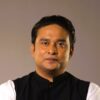
Narasimhan Ravikiran is an Indian slide instrumentalist, vocalist, composer, and orator, who created the concept of melharmony. He is the son of gottuvadhyam player Chitravina Narasimhan and the grandson of Narayan Iyengar, who was also a Carnatic musician.
Table of Contents
Narasimhan Ravikiran । Indian slide instrumentalist, vocalist, composer, and orator
Early life
Narasimhan Ravikiran was born in 12 February 1967, Mysore, Karnataka. He made his first appearance at the age of two, in April and again in August 1969, in Bangalore, and was interviewed by Semmangudi Srinivasa Iyer, Pandit Ravi Shankar, M S Subbulakshmi and Flute T R Mahalingam.
He also performed at the XLIII Madras Music Conference held at The Madras Music Academy in December 1969, and was awarded a scholarship from the academy. He was able to identify about 325 ragas (melodic scales) and 175 talas (rhythmic cycles) of Carnatic music.
Ravi Shankar is said to have declared “If you don’t believe in God, look at Ravikiran”. Soon after, he was presented at leading institutions such as Shanmukhananda Fine Arts, Bombay and Tyagaraja Sabha, Coimbatore.
Following training under his father, Chitravina Narasimhan, Narasimhan Ravikiran debuted as a vocalist in 1972, when he was five years old, in Coimbatore.[citation needed] He performed at concerts in Madras, Mysore and Bangalore until he was 10. His recitals – often over two and a half hours – drew large audiences and won critical acclaim in the Indian media.
Career
Ravikiran also established himself as a string instrumentalist at an early age. In July 1985, he set a record with a 24-hour non-stop solo concert in Chennai. He won an exemption to perform professional concerts for Indian Radio and Television (Doordarshan) at age 12 and was invited to represent his country in Festivals of India in France (1985), Switzerland (1987), Germany (1992), Brazil (2012) and countries like Poland, Czech Republic, Austria and Yugoslavia (1997).
He has performed extensively in major events and venues across the world including the Chicago World Music Festival, Theatre de la Ville Paris, Europalia Festival, Belgium, Millennium Festival (UK), Rudolstadt Festival, Germany, Masters of Indian Music, Budapest, Sadlers Wells & Tate Modern (UK), Esplanade Festival (Singapore), Oji Hall (Tokyo), Harborfront Festival, Canada, Cleveland Festival & Madison Festival (USA).
From 1986–96, Narasimhan Ravikiran trained with the vocalist T. Brinda. He is acknowledged for reviving classical values among the youth. He has performed with other artists and presented several concerts which include pure solos, duos with kanjira/ghatam/mridangam apart from conventional recitals with multiple accompanists and collaborations with piano, keyboard, guitar and other instruments.
He resumed his appearance as vocalist from 1999 and has since presented voice concerts for organizations in and outside India including the Cleveland Festival & the Chicago World Music Festival. His vocal albums include Genius at Work.
Ravikiran has introduced several technical innovations on the chitravina.
Composer
Narasimhan Ravikiran has created over 800 classical Indian and contemporary compositions. His Indian classical pieces include musical forms such as varnam, krti, javali, tillana and padam. He has created pieces in each of the 35-talas of Carnatic Music. as well as a 72-mela ragamalika geetam, a 13-part piece that spans over all the 72-parent ragas of Carnatic music in seven minutes.
He has created new ragas, including:
- Veetavanam in honour of Ludwig van Beethoven
- Mohini dedicated to Mahatma Gandhi
- Choodamani, created at age two and named after his mother
- Keshavapriya, Vaishnavi, Katyayani, Samapriya, Shivamanohari, and Andhakarini
Ravikiran has also set to music works of several azhwars, verses of Vedanta Desika, verses from ancientTamil sangam literature,compositions of Purandara Dasa, D V Gundappa and a few contemporary composers.
In January 2016, Ravikiran composed music to 1330 tirukkural verses in 16 hours over 3 days at the International Institute of Tamil Studies, Taramani, Chennai.
Operas
Ravikiran has also written a number of internationally staged operas:
- Lakshmi Prabhavam
- Savithri
- Vinayaka Vaibhavam
- Ramayana – Bala Kandam
- Ramayana – Yuddha Kandam
- Mahabharata (Karna Shapatam and Geetopadesham)
- The Almighty Trinity, a production composed entirely in Telugu, highlighting the harmonious interactions between Brahma, Vishnu and Shiva.
- Panchakriya
- Panchali Shapatam
Melharmony
Ravikiran is known for his concept of melharmony, which explores Western style harmony anchored on (Eastern style) melodic rules of evolved systems such as the raga system of Indian music. Melharmony is regarded as a ” a contemporary musical movement” with an aim to unify music systems of the worldby taking into cognisance the rules and aesthetics of all fused systems in any given collaboration. Ravikiran introduced this award-winning concept during his collaboration with artists of the BBC Philharmonic, at the Millennium Festival, UK in Oct 2000.
Melharmony concerts with major orchestras like Wisconsin Chamber Orchestra’s have attracted audiences of 45,000 people at times.The concept has inspired critical discussion among scholars in international conferences including Society for Music Theory Conference, Boston (2005) and Melody, Harmony, Melharmony conference, Houston (2014). Melharmony shows with School Orchestras have enabled middle and high school children in the West glean insights into how harmony can be centered on sophisticated rules of melody.
Ravikiran has also melharmonically rearranged and showcased the works of the great Masters in the twin-Composer series of festivals – OVK-Bach, Tyagaraja-Mozart and Dikshitar-Beethoven since 2013.
Collaborations
Ravikiran has created music for Western Classical Symphony Orchestras, Chamber Orchestras, String Quartets as well as Caprices for solo violins. He has collaborated with top-draw artistes of various genres such as Taj Mahal, Larry Coryell, Martin Simpson, George Brooks, Simon Phillips, Roland van Campenhout and orchestras such as BBC Philharmonic, Wisconsin Chamber Orchestra, Goettingen Quintet, Germany, Apollo Chamber Players, Houston, Middleton Community Symphony Orchestra and Sacramento Symphony.
Among Indian maestros, he has performed with Semmangudi Srinivasa Iyer, T. Brinda, Girija Devi, Pt Birju Maharaj, Dr M. Balamuralikrishna,Vishwa Mohan Bhatt, Dr N. Ramani, R. K. Srikanthan, Pt Kishan Maharaj, Nedunuri Krishnamurthy, Mandolin U Shrinivas and others.