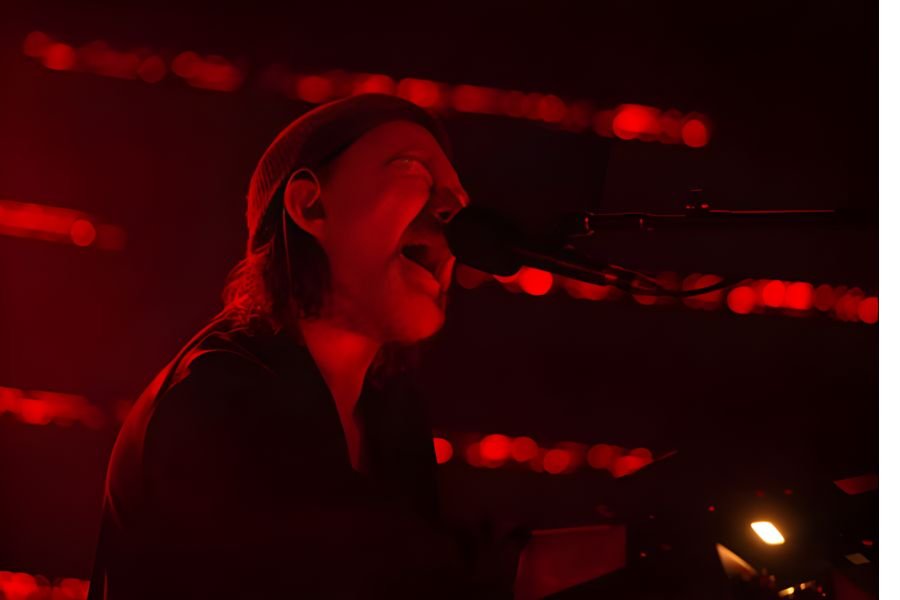
Radiohead’s first live performance in seven years was nothing short of electric, as the iconic band returned to the stage with a blistering set that had the crowd moving from start to finish. Performing in front of an eager audience at Madrid’s Movistar Arena, Radiohead showcased their unparalleled musicianship and ability to generate pure joy even in their most complex and challenging moments.
It’s been nearly a decade since Radiohead released a new album, and over seven years since their last concert appearance. In that time, the world has advanced in ways that mirror the dystopian futures often foretold in their songs. Themes of environmental disaster, societal collapse, and personal crisis—subjects that once seemed like hypothetical, abstract fears in Thom Yorke’s lyrics—now resonate more powerfully than ever in our troubled, rapidly changing world.
Though Yorke has earned a reputation as something of a soothsayer, the band’s return to the stage demonstrated that their appeal lies not just in his prophetic words but in the collective brilliance of all five members. While Yorke’s solo projects, including his recent collaborations with bandmate Jonny Greenwood in The Smile, have kept fans engaged, there’s been a long-held anticipation for Radiohead’s reunion, which was finally realised in a series of short residencies across European cities.
This first show in Madrid featured a striking set-up with the band performing ‘in the round’—taking different positions behind a gossamer projection screen that initially appeared to be some form of protective barrier. However, as the show progressed, it was clear that no such protection was needed. This was not a fragile return; it was a statement of strength.
The concert opened with the hauntingly beautiful “Let Down” from OK Computer, a fan favourite that has recently experienced a resurgence among younger listeners, particularly after its popularity on TikTok. The song’s delicate beauty, offset by Yorke’s wry self-awareness, was amplified by an intense, almost overwhelming rhythm section. With Greenwood’s complex guitar melodies intertwining with a thundering percussion section, the audience was immediately swept up in the band’s immersive sonic world.
Throughout the night, Radiohead performed 16 tracks, including some of their most iconic works like “2+2=5”, “Bloom”, and “Ful Stop”. These mid-to-late career tracks benefitted from a ferocious rhythm section, with drummer Phil Selway, percussionist Chris Vatalaro, and bassist Colin Greenwood (Jonny’s brother) delivering an extraordinary show of force. The basslines, in particular, were a highlight, with the deeply textured sound of Greenwood’s playing cutting through the arena’s cavernous acoustics.
The evening also included selections from Kid A, a record that signified a dramatic shift in the band’s sound. Tracks like “Everything In Its Right Place” and “Idioteque” were given new life on stage, transforming from icy sonic experiments into crowd-pleasing anthems. Even during these challenging, avant-garde moments, the audience responded with enthusiasm, clearly embracing the evolution of Radiohead’s music.
Despite the size of the arena, the atmosphere remained intimate, and by the time they played “15 Step”, even the furthest seats were bouncing to the intricately difficult drum patterns. Yorke, now almost 60, was still as spry as ever, playfully bouncing around the stage with the same intensity he had in his youth, reminding the crowd that “it comes to us all”—whatever “it” may be.
The setlist may have excluded some fan favourites from A Moon Shaped Pool and The Bends, which disappointed some purists, but early hits like “Fake Plastic Trees” delivered explosive energy, “blowing through the ceiling” in a way that far surpassed the studio recording. The crowd roared in approval as the band performed with a sense of genuine joy and vitality that transcended mere nostalgia.
Radiohead’s live performances have always been a release from the creative pressures of the studio, and tonight’s performance was no different. However, this time, there was an additional layer of energy and excitement, as if the band was revitalised by their time away. Yorke, typically reserved, kept his words to a simple “gracias,” but his performance spoke volumes. The joy he and his bandmates radiated was palpable, and it was clear that Radiohead’s return was not just about revisiting old material, but about reconnecting with their fans in a moment of shared exhilaration.
For anyone who has loved this band through the years, it was a reminder of what makes Radiohead unique: they are a band that refuses to sit still, both musically and artistically. With this performance, they reaffirmed their place at the forefront of rock music, not as relics of the past but as pioneers still pushing the boundaries of what live music can be.